Class of 2029. MIT's own published figures, not a reconstruction.
USA · Computer Science·28 min read
How Can an International Student Get Into MIT Computer Science? (2027 Guide)
A calm, honest guide for students and parents. Built on real data. No hype. No fear. Just what actually works.
Published · Updated
You cannot apply to MIT for Computer Science
That is not a technicality, and it is not us being clever. It is the single most important thing to understand before you spend another month planning.
MIT does not admit students by major. You apply to MIT. That is all. Then, in the spring of your first year, you choose what to study.
MIT says this in plain words on its own site: "Students apply to MIT for general admission and select a major at the end of the first year with the help of their first-year advisor." The application asks for your "course of interest," and MIT states that the choice "doesn't have any impact on admission decisions." (MIT Admissions FAQ: majors)
So there is no MIT Computer Science acceptance rate. There cannot be one.
If you have seen a page quoting "6 to 8% for computer science," that number is invented. No official MIT source publishes it, because the thing it measures does not exist.
This matters more than it sounds. It changes what you should worry about, and what you can stop worrying about today.
RMC Insight
Students spend months optimising for a gate that is not there. The real question is not "can I get into MIT for CS." It is "can I get into MIT." Once you are in, Computer Science is not a competition. We will show you why in a moment.
Stop hunting for a CS acceptance rate. There is not one. Plan for getting into MIT as a whole, because that is the only gate there is.
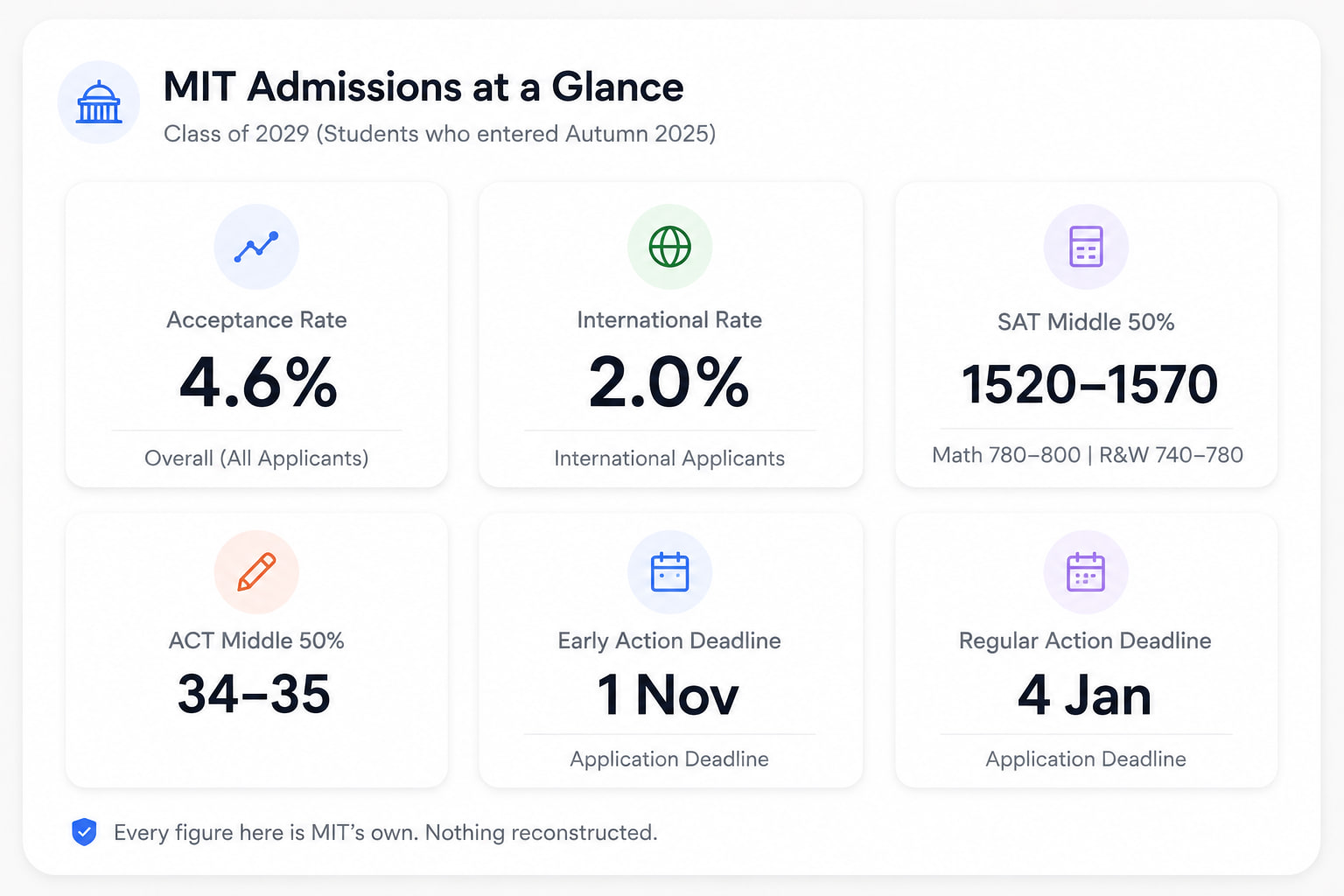
Quick MIT facts, Class of 2029
These are MIT's own published numbers for the most recent complete cycle, students who entered in autumn 2025. Sources: MIT admissions statistics and the MIT Common Data Set 2025-26.
Applications: 29,281
Admitted: 1,334
Enrolled: 1,152
Overall acceptance rate: 4.6%
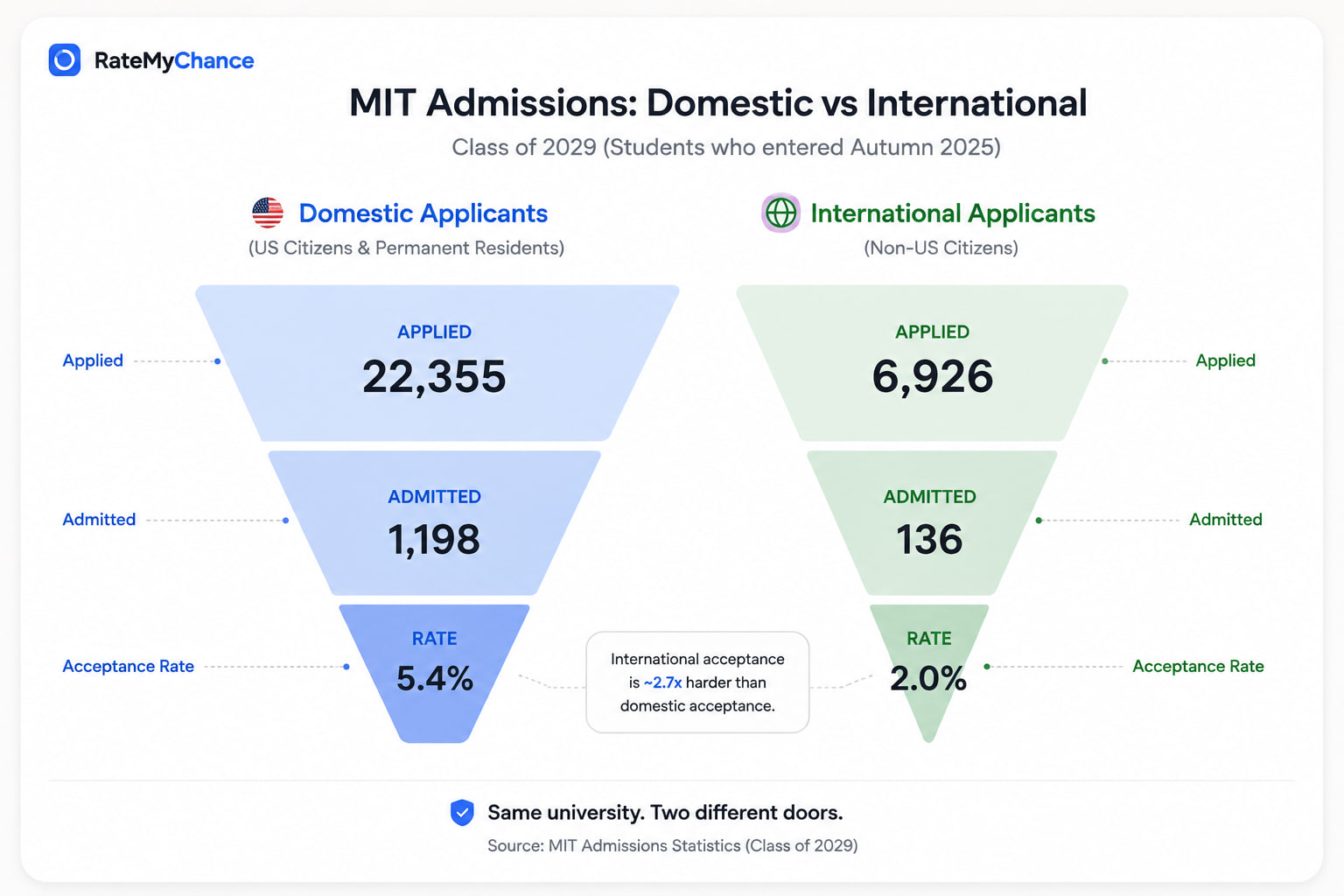
US applicants: 22,355 applied, 1,198 admitted, 5.4%
International applicants: 6,926 applied, 136 admitted, 2.0%
SAT middle 50%: 1520 to 1570. Maths 780 to 800. Reading and Writing 740 to 780
ACT middle 50%: 34 to 35
Early Action: 12,052 applied, 721 admitted, 6.0%
Regular Action: 603 admitted from 24,715 considered, 2.4%
International share of the first-year class: 11%, from 56 countries
Class of 2029: students who entered in autumn 2025, MIT's most recent complete cycle.
For the Class of 2030, which entered in autumn 2026, MIT has published only the headline: 28,349 applied, 1,299 admitted, 4.58%, from 58 countries. It has not yet released the international split. So we use the Class of 2029 for anything more detailed, and we tell you which is which.
Before you rely on this
Every figure here is MIT's own, last checked in August 2026. Deadlines, test policies and aid thresholds change most years, so confirm anything you plan around against MIT's own pages. Every one we used is listed at the foot of this guide. Where MIT and this page disagree, MIT is right and we are stale.
The number that actually applies to you
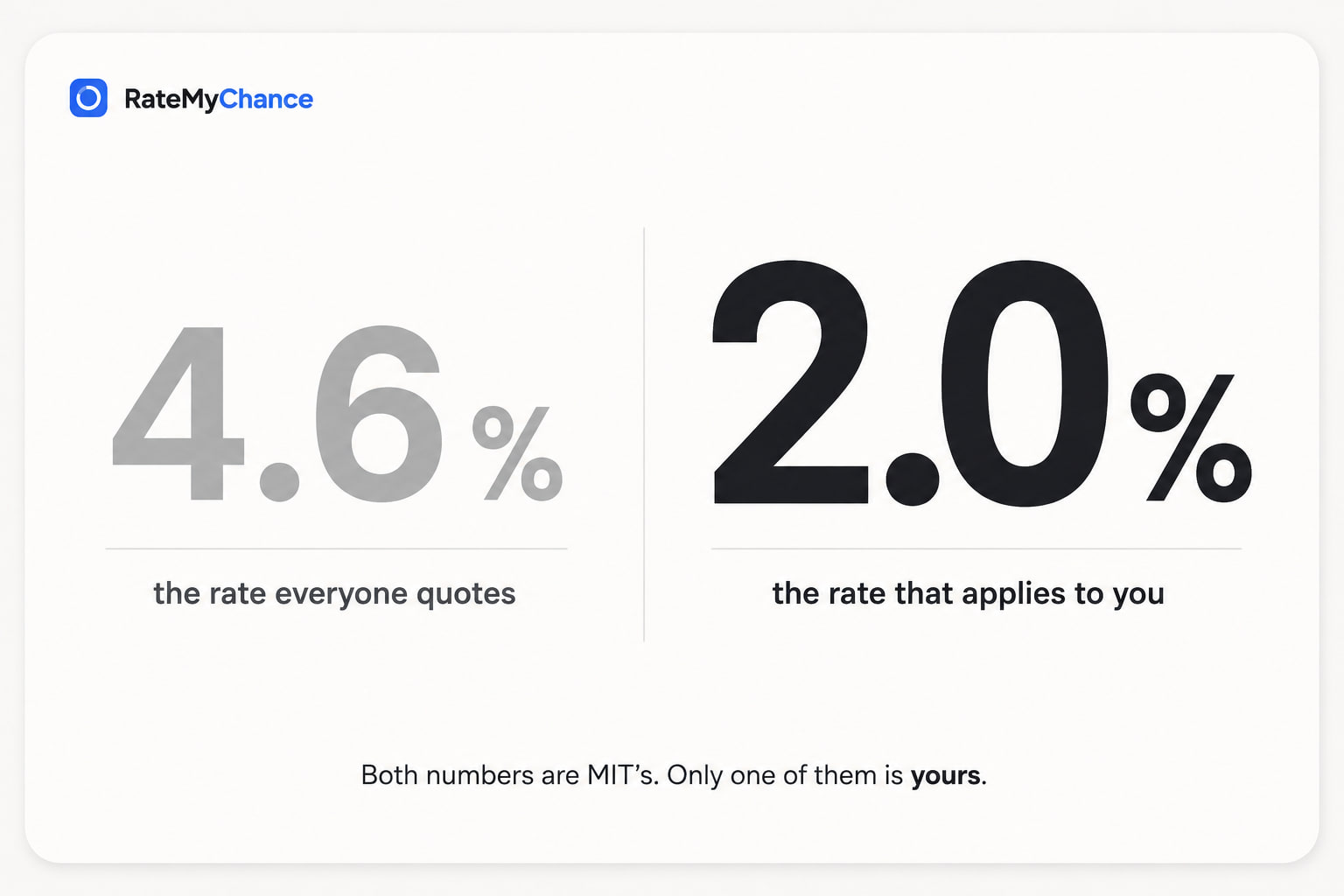
Almost every article you will read quotes 4.6%.
That is the blended rate. It is not your rate.
MIT publishes the split in its admissions statistics, and the split is stark. Domestic applicants were admitted at 5.4%. International applicants were admitted at 2.0%.
That is not an estimate. It is 136 divided by 6,926, using MIT's own published figures.
International admission to MIT is roughly two and a half times harder than domestic admission.
We are telling you this early, and plainly, because the alternative is worse. If you plan around 4.6%, you will build a college list that cannot hold your weight.
Class of 2029. Both funnels are drawn on one shared scale, so the columns are directly comparable.
RMC Insight
A hard number told early is kinder than a soft number told late. The students who struggle most in March are not the ones who knew the odds. They are the ones who were told the odds were fine.
Build your college list around 2%, not 4.6%. Every other school on that list should be one you would be glad to attend.
MIT in 30 seconds
If you read nothing else on this page, read this.
You do not apply by major. You apply to MIT.
You declare Computer Science in the spring of your first year, and it is uncapped.
The international acceptance rate is about 2%, not the 4.6% everyone quotes.
Character is the only factor MIT rates "very important."
MIT is need-blind and meets full need for international students, which is rare.
You may list four activities. That is all.
MIT does not use the Common App. It has its own portal.
Everything else here is the long version of those seven lines.
For Indian students, one more number
MIT's International Students Office publishes enrolment by country, and you can look this up yourself. Source: MIT ISO statistics 2025-26.
For 2025-26, MIT had 16 undergraduate students holding Indian citizenship. That is the total across all four year groups, not one intake. So a typical year brings in about four.
Two caveats, because the number is easy to misread. It counts citizenship, not heritage, so the many US citizens and permanent residents of Indian origin at MIT are not in it. And an Indian passport holder studying in Dubai or Singapore may be counted differently.
What it means is simple. MIT should be one line on your list. It should never be the plan.
That is not discouragement. It is what lets you apply with a light heart instead of a clenched one, which produces better essays anyway.
Not from India? Look up your own number. MIT's International Students Office publishes undergraduate enrolment by country, updated each year. For scale, in 2025-26 China had 65 undergraduates, Canada 20, South Korea 13. Find your country, divide by four, and you have your realistic annual figure. Then build your list around it. The arithmetic is uncomfortable everywhere, and it is better known than guessed.
What this means for you
Look up your own country's number before you plan anything. Then build a list where MIT is one line on it, never the plan.
What happens if you get in: the part nobody writes about
Here is the good news that the anxiety hides.
Once you are at MIT, Computer Science is not gated.
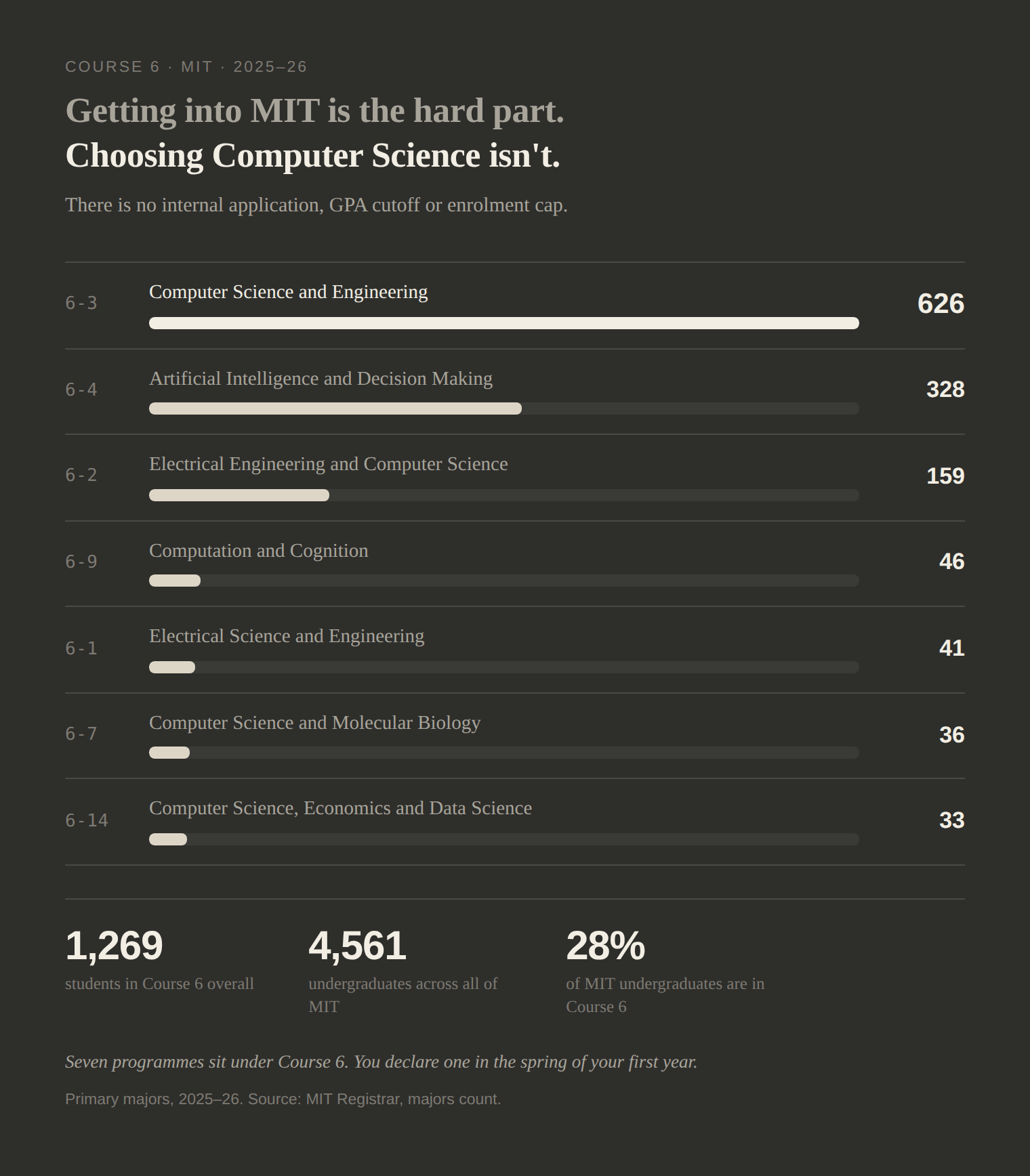
There is no internal application. No GPA cutoff. No cap on numbers. If you want to major in Course 6, you declare it in the spring of your first year, and you are in.
This is genuinely unusual. At Berkeley, Carnegie Mellon, Georgia Tech and many others, CS is a separate and far more competitive admission, and being admitted to the university does not mean being admitted to CS.
At MIT, it does.
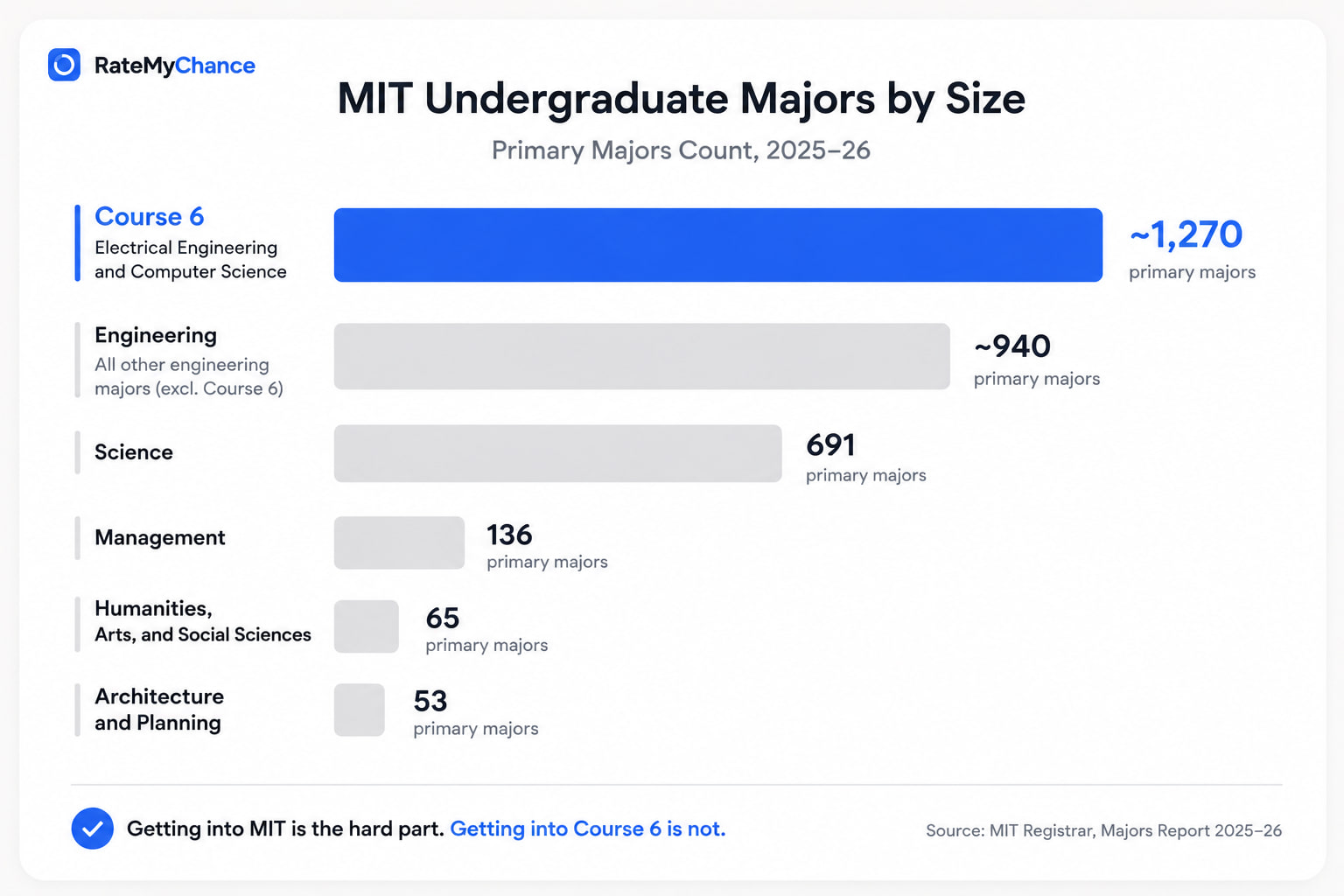
And Course 6 is not a small corner of campus. Source: MIT Registrar, majors count 2025-26.
Primary majors by programme, 2025-26, from the MIT Registrar's majors count.
That is roughly 1,270 primary majors, out of about 4,561 across all of MIT. Course 6 is the largest department on campus by a wide margin. 6-3 alone is bigger than most entire MIT departments.
Primary majors by school, 2025-26. Course 6 is counted on its own, separately from MIT's other engineering courses.
So the sentence to carry with you is this. Getting into MIT is extraordinarily hard. Getting into Computer Science, once you are there, is not hard at all.
RMC Insight
Notice what this does to your strategy. Every hour you were going to spend making yourself look like "a CS person" is better spent making yourself look like a person MIT wants. Those are not the same thing, and only one of them is being assessed.
Stop trying to look like a CS student. Spend those hours becoming a person MIT wants, because that is the only thing being judged.
The four boxes
MIT lets you list four activities. Not ten. Not twenty. Four, and there is no résumé upload.
Most guides mention this and move on. It is worth sitting with, because it is the single most revealing constraint in the whole application.
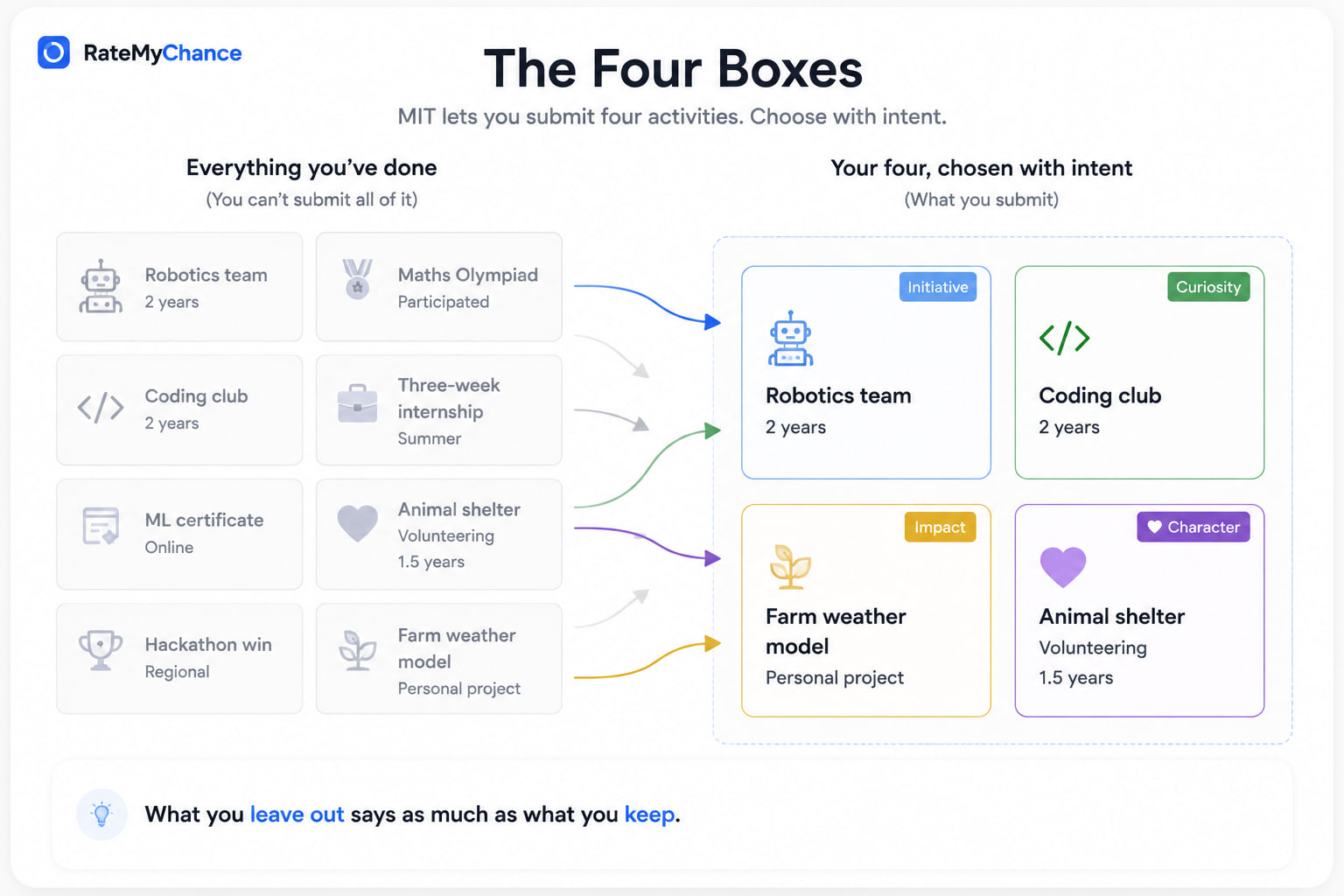
Meet Ishaan. By the end of Class 12 he has eight things he could list.
A school robotics team, three years. A district maths Olympiad, participated, no medal. A coding club he co-founded. Three weeks at a cousin's software firm. A machine learning certificate from an online course. Two years volunteering at an animal shelter. A hackathon win. And a weather prediction model for his father's farm, which he has been rebuilding badly since Class 9.
Eight things. Four boxes.
The version of Ishaan that fails picks by prestige. Hackathon win, Olympiad, internship, robotics. Every one is legible. Every one sounds impressive. Not one of them explains any of the others.
The version that works picks by evidence. The farm model, the robotics team, the coding club, and the animal shelter.
Look at that fourth choice. The animal shelter has nothing to do with computer science. That is precisely why it stays. MIT rates character above every other factor and asks, in writing, "What do you do just for fun?" A student who has only ever optimised has no answer to that question, and it shows.
The internship goes, because three weeks at a relative's firm evidences nothing. The certificate goes, because a certificate is a receipt, not a result. The Olympiad participation goes, because participation is not distinction, and listing it as though it were tells MIT something you did not mean to say.
Ishaan's eight, narrowed to four. Each one he keeps carries a different Admission DNA strand.
RMC Insight
The four-box limit is not a cruelty. It is a forcing function. MIT is making you do the editing that admissions officers elsewhere have to do for themselves. What you cut tells them as much as what you keep.
Write down everything you have done, then cut it to four. If the four do not explain each other, cut again.
What MIT says it is looking for
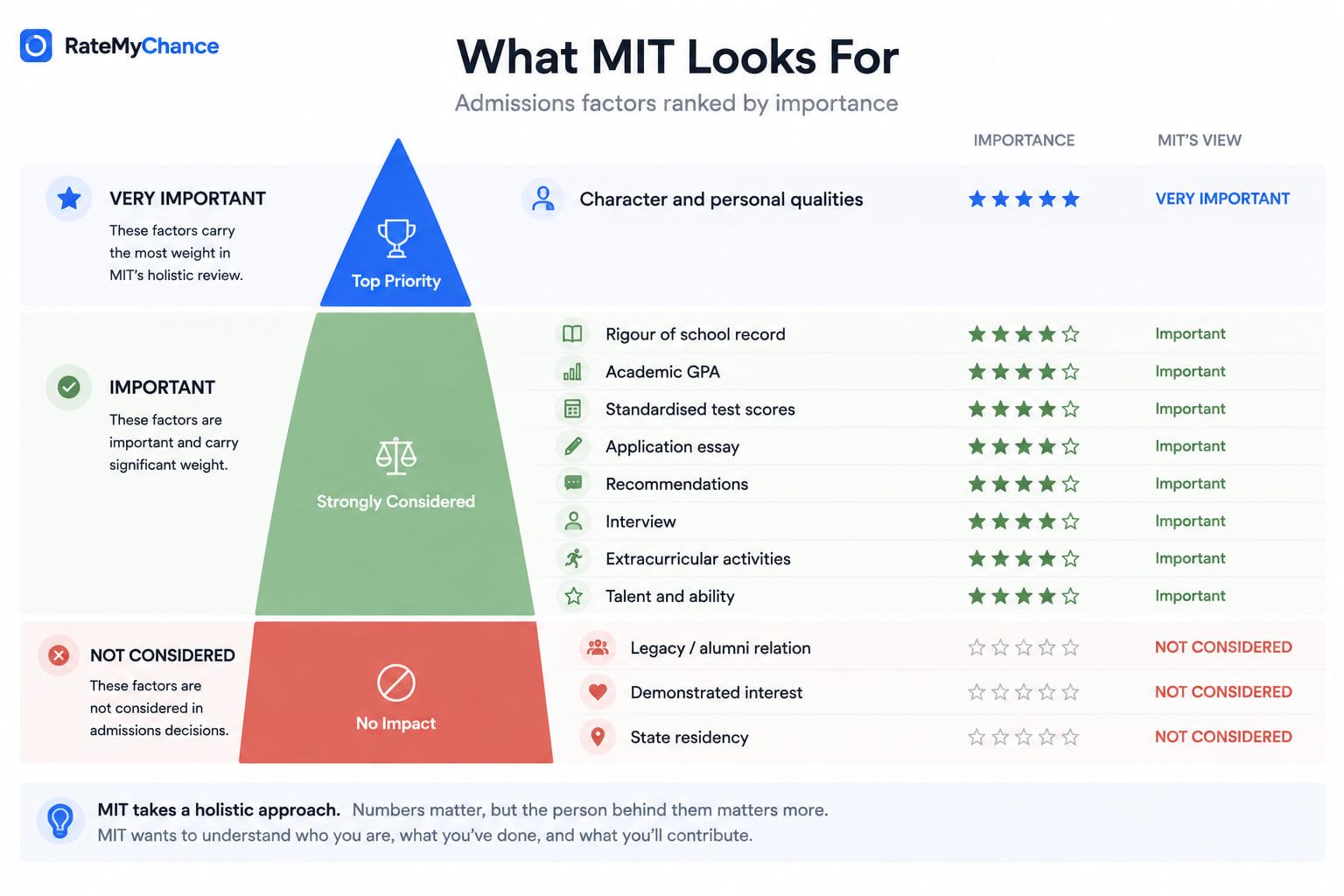
MIT publishes its own weighting, and you can check it yourself. Source: MIT Common Data Set 2025-26, section C7. It is worth reading closely, because it is surprising.
Ranked by weight. MIT reports all eleven factors in its Common Data Set 2025-26, Section C7.
Read the top line again. The single factor MIT weights above all others is character.
And read the bottom three. There is no legacy preference at MIT. And emailing admissions to show enthusiasm does precisely nothing, which saves you a great deal of anxiety in December.
In their own words
"There is nothing, literally nothing, that in and of itself will get you in to MIT."
MIT's own admissions officer, Chris Peterson, put the point more bluntly than any consultant will. His example is a student who built a working nuclear reactor in his garage and was not admitted. (Applying Sideways, MIT Admissions)
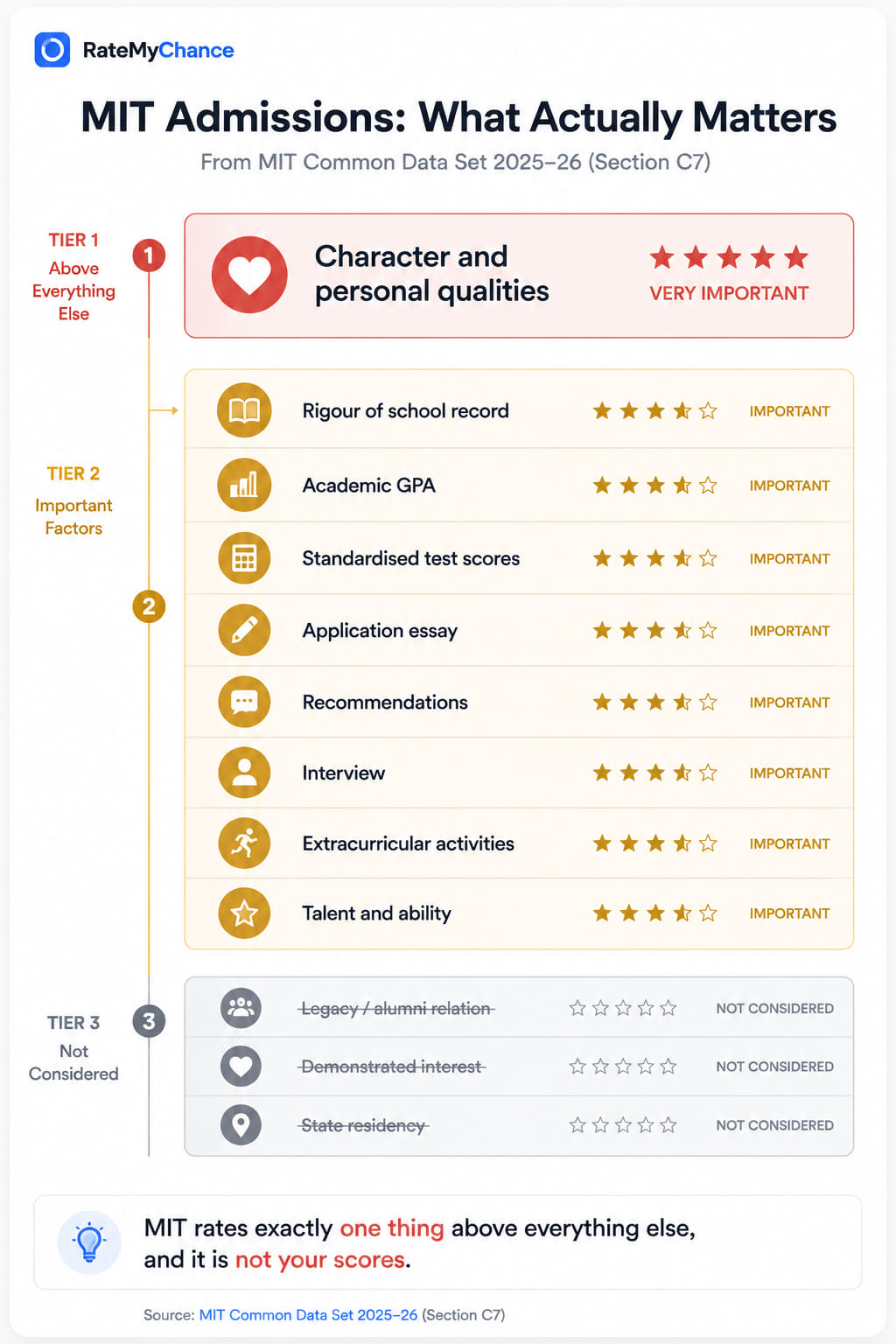
Here is the same weighting as MIT actually files it, tier by tier, in the Common Data Set:
The full filing: three tiers, eleven factors, in MIT's own labels.
What this means for you
Character is the top factor, so build it on purpose. Keep one thing in your four boxes that has nothing to do with computer science.
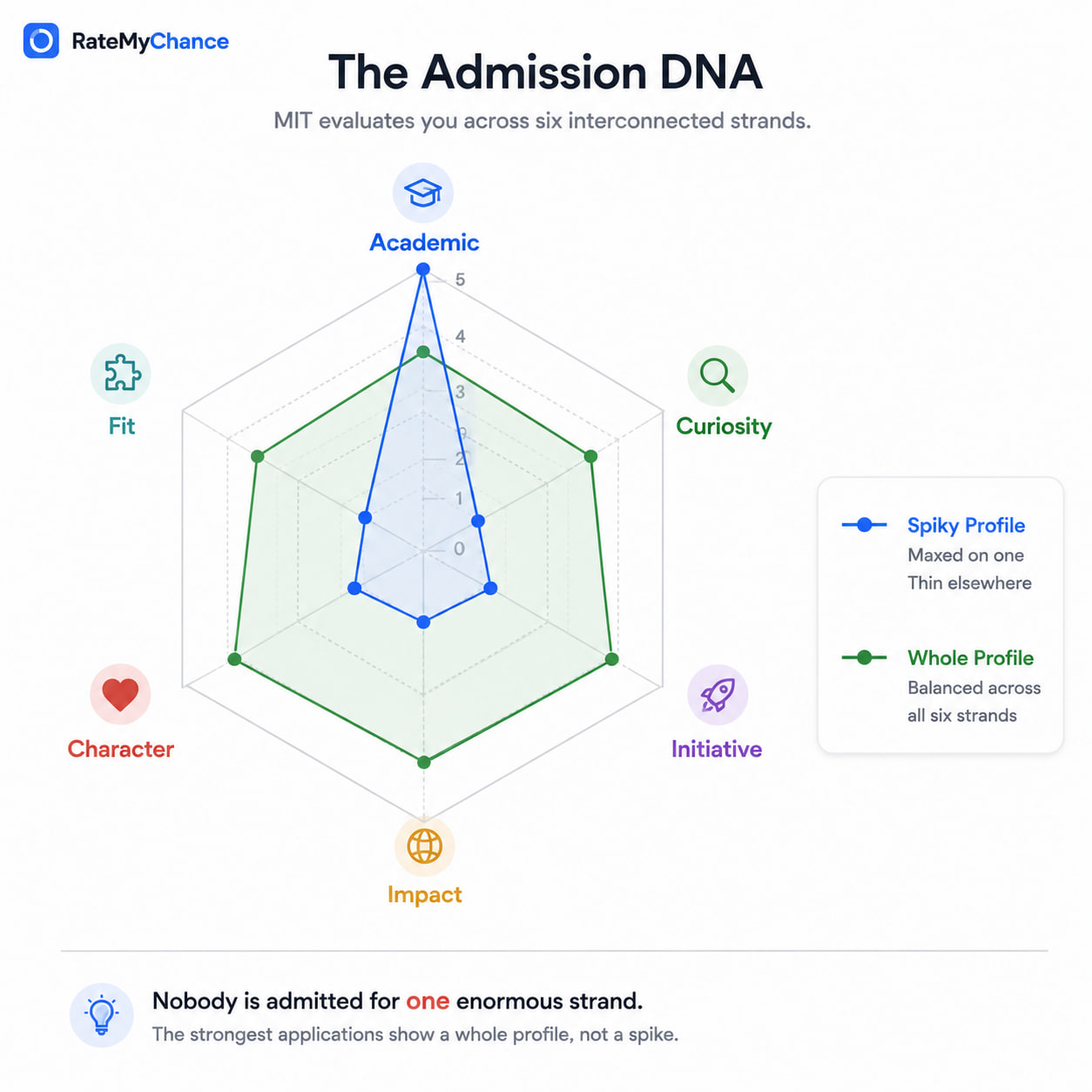
Admission DNA: the six strands
"Character" is a hard word to act on. So here is how we break down what any selective university is actually reading, across six strands.
🧠 Academic. Can you handle the work? This is the entry ticket, and nothing more.
🔍 Curiosity. Would you keep learning if nobody graded you?
🚀 Initiative. Do you start things without being told to?
🌍 Impact. Has anything you made changed anything for anyone?
❤️ Character. Who are you when there is nothing to win?
🎯 Fit. Does MIT specifically make sense for you, or would any famous name do?
Most rejected applicants are spiky. Enormous on Academic, thin everywhere else. Years of work poured into the one strand that MIT explicitly treats as a threshold rather than a differentiator.
The four boxes above are really a DNA exercise. The farm model carries Initiative and Impact. The coding club carries Initiative. The robotics team carries Academic and Fit. The animal shelter carries Character, which is the strand MIT rates above all others and the one every applicant leaves empty.
RMC's model, not MIT's. These are the six strands we score in every report.
What this means for you
Score yourself one to five on all six strands. Then work on your lowest strand, not your highest.
How admissions actually reasons
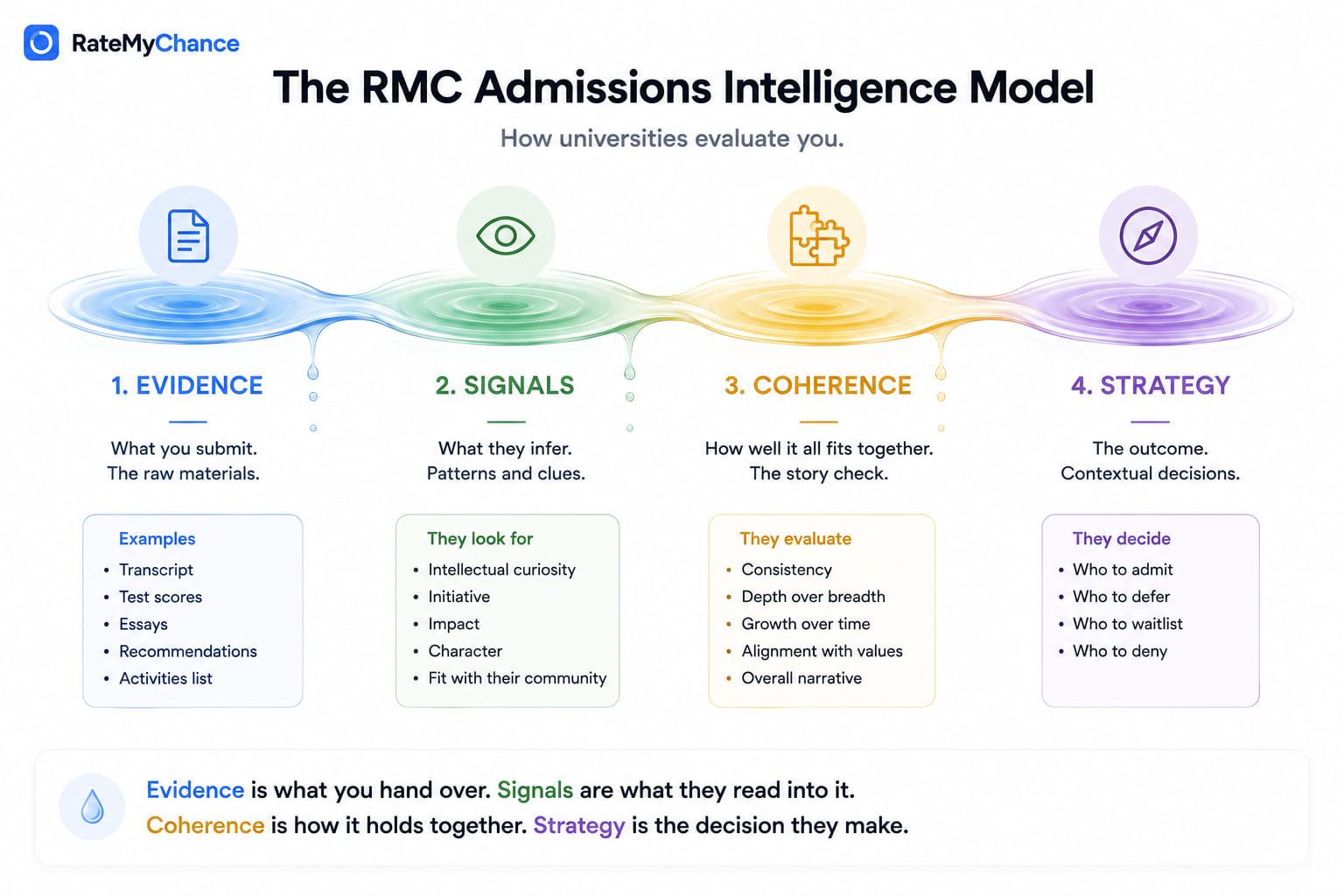
Selective admissions is not a scoring machine. It is a reasoning process, and it runs in one direction.
Evidence is everything you hand over. Grades, tests, four activities, essays, letters, the interview, and the context you come from.
Signals are what a reader infers from that evidence. Not "she built an app" but "she finishes things." Not "he won a hackathon" but, sometimes, "he chases prizes."
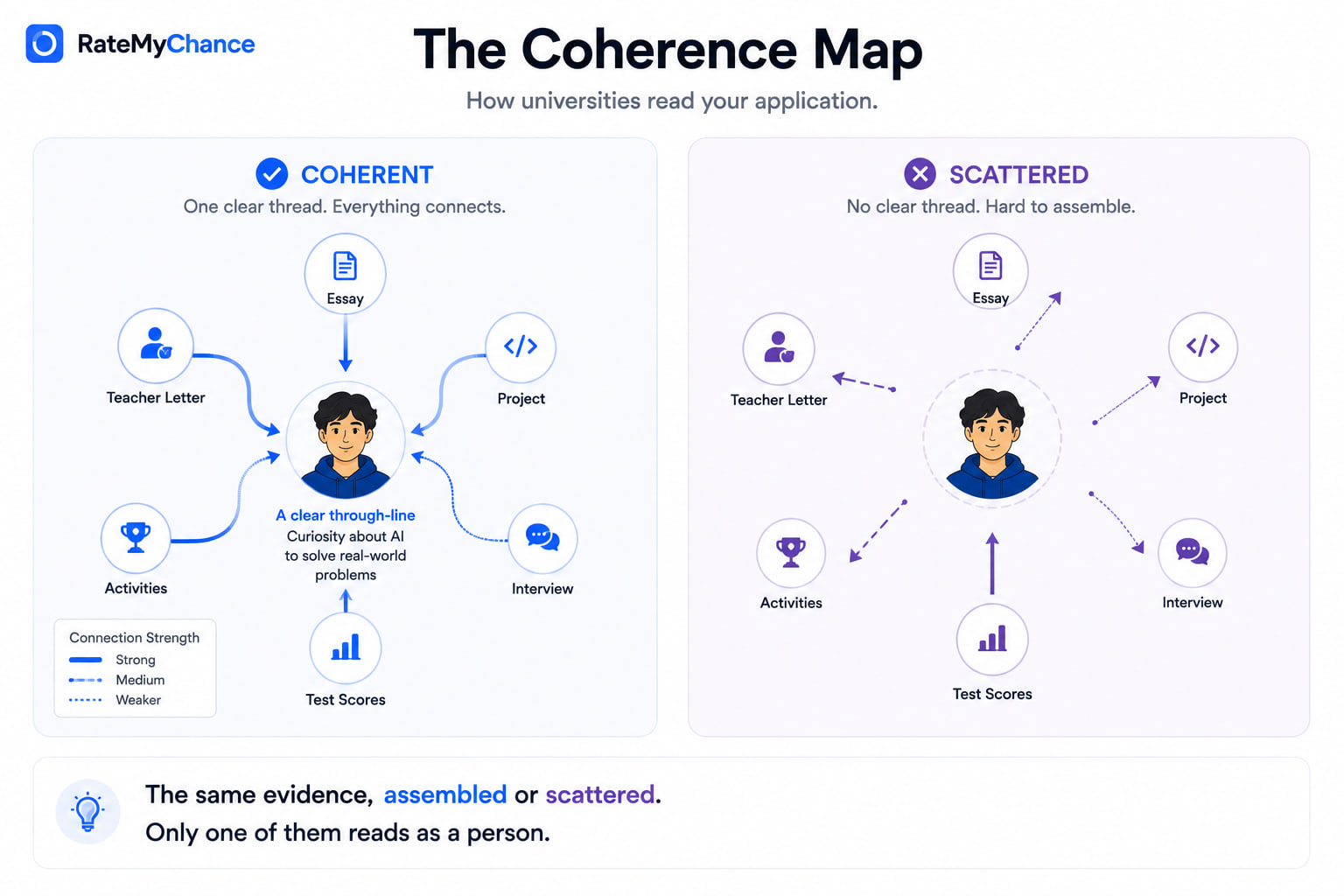
Coherence asks whether all of it tells the same story. Does the teacher's letter describe the person the essay describes? Does the activity list explain the interest the essay claims?
Strategy is what you do next, once you can see the gaps.
This is why two applicants with identical scores get different answers. The evidence was equal. What a reader could infer from it was not.
The RMC model behind every guide and report on this site.
What this means for you
Read your own application as a stranger would. If you cannot say in one sentence what it shows about you, a reader cannot either.
The Olympiad question
This is the fear we see most often from international applicants, and it is usually phrased as a deficiency. "What can I use to compensate for not having an Olympiad medal?"
Here is the honest answer, which sits between the two things you will usually be told.
An Olympiad medal is not required. MIT has never said it is, and students without them are admitted every year.
But it is also not nothing. In the compressed international pools, especially India and China, nearly every applicant has excellent grades and scores. A national or international medal is one of the few credentials that is instantly legible as extraordinary depth.
So the medal is not a checkbox. It is one way to be legible. Your job is not to acquire that particular credential. Your job is to become legible some other way.
Ishaan's farm weather model is legible. Four years, a real user who is his own father, documented failure, and a reason that is obviously his. No medal required.
RMC Insight
"Compensate" is the wrong verb. You are not filling a hole where a medal should be. You are building the thing that makes the medal unnecessary.
Stop trying to replace a medal. Build one thing deep enough, and documented well enough, that nobody thinks to ask whether you have one.
MIT's application is different, and this catches people out
MIT does not use the Common Application. It does not use the Coalition Application.
MIT has its own portal, at apply.mitadmissions.org. If you are working through a Common App list, MIT will simply not be on it. Every year, students discover this in December.
Then five structural facts that change how you prepare, none of which apply at most universities:
You may list four activities. Four. Not ten, not twenty. There is no résumé upload. See the four boxes above, because this constraint decides more than anything else on the form.
There is no long personal statement. MIT uses several short answers instead. Four responses of roughly 100 to 200 words, and four of roughly 40 to 50 words. The short ones include "What do you do just for fun?" and "What's a topic you could talk about for hours?"
That format rewards a real voice and punishes coached prose. There is nowhere to hide behind structure. MIT's admissions officers have publicly shared their own answers to the "for fun" question, listing things like anime and powerlifting, precisely to show that the correct answer is honest rather than impressive.
Two recommendation letters, one from a maths or science teacher, one from a humanities, social science or language teacher. MIT notes this is not an absolutely rigid requirement where a school's structure makes it impossible.
Test scores are self-reported. You do not need to pay for official score reports when you apply. MIT verifies them only when you enrol. For international families this saves real money.
The application fee is $75, and fee waivers are available to international applicants. Most people assume they are not. They are, and you request one inside the application.
What this means for you
Open apply.mitadmissions.org today and read the actual form. MIT is not on the Common App, and the shape of its questions changes what you should prepare.
Testing, honestly
MIT requires the SAT or ACT. It reinstated the requirement in March 2022 after two test-optional years, and MIT's stated reason is directly relevant to you: alternative measures show "immense disparities between schools," while the maths section "substantially improves the predictive validity of our decisions."
The middle 50% of enrolled students, Class of 2029. Source: MIT admissions statistics.
SAT total: 1520 to 1570
SAT Maths: 780 to 800
SAT Reading and Writing: 740 to 780
ACT composite: 34 to 35
One honest note on the data. MIT's admissions page lists the ACT composite as 34 to 36, while MIT's Common Data Set lists 34 to 35. Two official MIT sources disagree. We use the Common Data Set because it is the more tightly defined instrument.
Some practical points:
MIT superscores, taking your best section across sittings. But MIT asks you to report all sittings, so this is not free score-shopping.
Test deadlines are the November test date for Early Action, and the December test date for Regular Action.
99.16% of enrolled students scored between 1400 and 1600. Below 1400 is close to unheard of.
On GPA, MIT publishes nothing. Its Common Data Set lists average high school GPA as "not available." Every site quoting "MIT average GPA 4.17" is reconstructing that from third-party surveys. What MIT does publish: of the enrolled students whose schools reported class rank, 97% were in the top tenth and 100% in the top quarter.
English proficiency is strongly recommended if you have used English for fewer than five years, or do not use it at home or in school. TOEFL 100 recommended, IELTS 7.5, Duolingo 125. Check the live page, since TOEFL's scale has been changing.
MIT is the rare university that argued publicly for the test, and its reasoning tells you how to use it. MIT reinstated the requirement because the maths section "substantially improves the predictive validity of our decisions." Not the composite. The maths. So the widely repeated advice to lift your weakest section does not apply cleanly here. If your maths is 740 and your reading is 700, MIT's own stated logic says fix the maths. And once maths is at 790, further points in either section are close to worthless, because you have already given MIT the one number it said it wanted.
What this means for you
If your SAT maths is below 780, that is your priority. Once it reaches 790, stop testing and go build something.
APs, and the one that is worthless to you
Two separate questions get tangled here. Whether APs help you get in, and whether they buy you anything once you are there.
For admission, APs are not weighted on their own. MIT's Common Data Set has no line for them. They contribute to "rigour of secondary school record," which sits in the Important band alongside seven other factors. CBSE, ICSE, IB and A-Levels do exactly the same job, and MIT's counsellors are trained on all of them. If your school does not offer APs, you have lost nothing. Taking them privately, at cost, to look more American is one of the more expensive mistakes in this market.
For credit, MIT is stingier than almost any university you will apply to. Source: MIT Office of the First Year and MIT Admissions, transfer credit.
What a 5 actually earns you:
Calculus BC: credit for 18.01
Calculus AB: placement into the accelerated 18.01A/18.02A sequence
Physics C, both Mechanics and Electricity & Magnetism: credit for 8.01
Any Arts, English, History or World Languages AP: 9 units of elective credit
And what earns you nothing at all:
AP Computer Science. Either exam. No credit.
AP Biology. AP Chemistry. AP Statistics. AP Environmental Science. Physics 1 and 2 taken separately.
Read that first line again, because it is the one that matters on this page. The AP most closely associated with your intended field is the one MIT gives you nothing for. A student loading up on AP Computer Science to look serious about MIT CS is doing something that neither helps the application nor shortens the degree.
RMC Insight
This is MIT telling you something about itself. It does not accept that a school exam has taught you its subject. Course 6 starts where it starts, for everyone. Which is oddly freeing: there is no AP shortcut to be anxious about missing.
Do not take AP Computer Science for MIT. It earns no credit and no advantage. Take the hardest maths and physics your school offers instead.
Early Action, and one rule that surprises people
MIT has non-restrictive Early Action. There is no Early Decision at MIT. You can apply early to MIT and early elsewhere at the same time, and you are not bound to attend.
Since 2015, international students may apply Early Action. Older pages still say they cannot. Those pages are wrong, and some of them are MIT's own archived posts.
The rates, Class of 2029: Early Action 6.0%, Regular Action 2.4%. Source: MIT admissions statistics.
Do not read that as an advantage. MIT states there is "no advantage or disadvantage to applying for either round." The gap is mostly self-selection, and the fact that deferred applicants get folded into the regular pool.
Two things that genuinely matter:
MIT defers a lot. 62% of the Early Action pool was deferred rather than denied. A deferral from MIT carries very little information. Of those deferred, about 2.3% were admitted later.
An Early Action denial is final. MIT states that students denied in Early Action are not eligible to apply Regular Action. This is unusual and many applicants do not know it.
Deadlines for the current cycle: Early Action closes 1 November, decisions mid-December. Regular Action closes 4 January, decisions mid-March. Financial aid materials by 15 February. Reply by 1 May.
One caution: MIT's own FAQ page says 5 January for Regular Action while its main deadlines page says 4 January. Submit by 4 January and the contradiction cannot hurt you.
These are the dates for the current cycle. Yours may differ. Confirm every one of them against MIT's deadlines page before you plan around them, because a date you took from an article is not a date you can hold anyone to.
What this means for you
Only apply Early Action if your application is genuinely ready in October. A denial in December is final, and you cannot try again in the regular round.
The maker portfolio, which almost everyone gets wrong
MIT lets you submit an optional maker portfolio. It is reviewed in SlideRoom by a separate panel of MIT faculty and alumni with maker experience, not by your admissions officer, and their rating is fed back into your file.
Here is the line that changes everything, from MIT: they are "more interested in your build process than your end results." And: "We can only review projects where you have provided sufficient evidence and documentation of your build process." (MIT maker portfolio FAQ, MIT portfolios and additional material)
Read that twice.
A beautiful finished product with no documented process scores worse than a modest project with photographs of its failures, its revisions, and its dead ends.
Video is capped at two minutes across the entire portfolio.
And "optional" is real. A weak portfolio is not neutral. It occupies expert reviewer attention and returns a mediocre rating attached to your file. If you do not have documented process, do not submit.
Software counts. Most CS applicants either do not realise this, or submit a bare GitHub link with no build narrative, which is the worst of both worlds.
What this means for you
Start photographing your work today, including what breaks. If you have no documented process by month ten, do not submit a portfolio at all.
The interview, and why not getting one is not a verdict
MIT interviews are conducted by Educational Counsellors, a network of over 3,500 MIT graduates who volunteer worldwide.
You are not guaranteed one. Coverage depends on how many volunteers live near you, which is thin in many Indian cities.
MIT states directly: "If we are unable to offer you an interview, it will be waived and your application will not be adversely affected." (MIT interviews)
We quote that verbatim because every year, students spend December convinced that no interview means no chance. It is a scheduling fact about your city, not a message about you.
If you do get one, it counts. MIT rates the interview as "important" in its own weighting. Early Action interviews are usually in November, Regular Action in January.
What this means for you
Read nothing into not getting an interview. Prepare as if you will get one, and let it go if it never comes.
Money, and the fact that changes everything
If your family has looked at MIT's sticker price and quietly decided it is impossible, read this section carefully. It is the most consequential thing on this page.
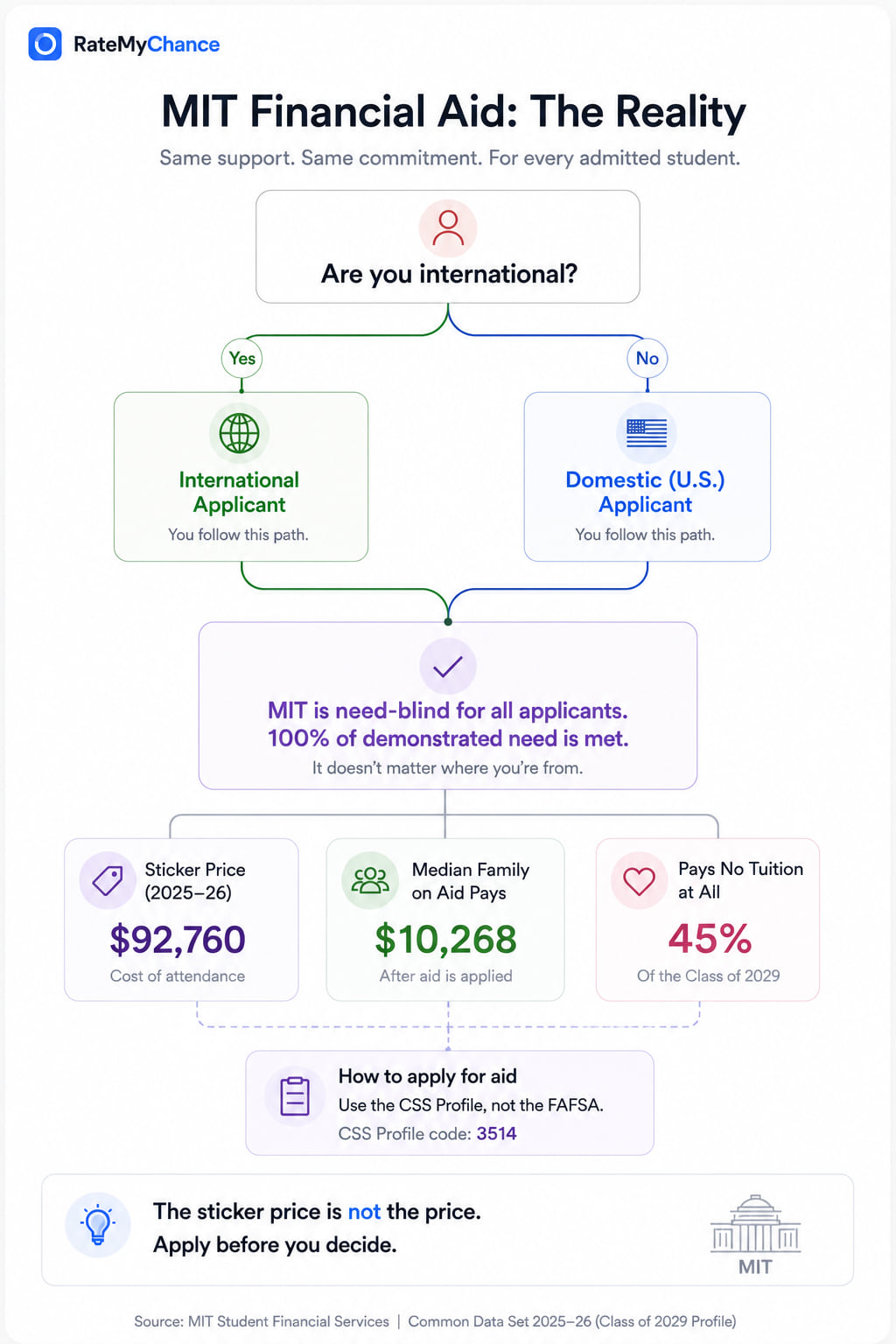
MIT is need-blind for all applicants, including international students. MIT states: "Our admissions process is need-blind for all students, foreign and domestic." (MIT Admissions FAQ: need-blind admissions)
MIT meets 100% of demonstrated need for international students. MIT describes itself as "one of only nine schools in the U.S. that is need blind and meets full need for all students, foreign and domestic." (MIT Admissions FAQ: international admissions, MIT Student Financial Services)
Almost every other American university is need-aware for international applicants, meaning your ability to pay affects your chances. At MIT it does not.
The numbers. Source: MIT Common Data Set 2025-26, section H, and MIT Student Financial Services.
Average need-based grant, all undergraduates: $71,120
Average institutional grant to international students: $81,991, across 411 recipients
Percentage of demonstrated need met: 100%
Median net price for aid recipients: $10,268
45% of the Class of 2029 attend tuition-free, families under $200,000
The international average is higher than the overall average, because international students cannot access US federal aid, so MIT's own grant covers more.
Sticker price for 2026-27 is $92,760. The median family receiving aid pays about a ninth of that.
2025-26 figures, from MIT Student Financial Services and the Common Data Set.
The mechanism: CSS Profile, MIT code 3514, not FAFSA. Plus your parents' tax returns through College Board IDOC. If your parents file taxes outside the US, you submit that country's return with an English translation.
We are labouring this because we have watched families self-eliminate before applying, over a number that was never going to be their number.
What this means for you
Apply for aid before you decide you cannot afford it. Use the CSS Profile, code 3514, and get your parents' documents ready early.
Three worries you only get at MIT
These are not the usual reassurances. Each one is a fear created by something specific in MIT's own rules, and each is answered by another of MIT's own rules.
"My four activities look thin next to everyone else's ten." Nobody has ten. MIT never sees a long list from anyone, including the student who has been building since Class 6. Everyone arrives at the same four boxes, and the only variable left is depth. That is the rare constraint that helps the student with less.
"I have nothing to put in a maker portfolio." Then do not submit one, and lose nothing. It is genuinely optional, and a thin portfolio is worse than none because it returns a mediocre expert rating into your file. If you have been building something and photographing it as you go, you have a portfolio. If you have not, you have a project, and that is still worth four-box space.
"Everyone says Indian applicants are penalised." MIT states it applies no country quotas and does not convert grades to American equivalents. The pool is brutally self-competitive, which is a different thing from a penalty. The distinction matters, because one of those you can respond to and the other you cannot.
And one practical thing nobody says out loud. If the $75 application fee is the obstacle, MIT offers fee waivers to international applicants, requested inside the application itself. Families skip MIT over this every year without ever discovering it exists.
What this means for you
Every one of these fears is answered by a rule MIT has already published. Check the rule before you believe the fear.
The passion project trap
The phrase "passion project" comes from MIT, and MIT is also the university that most explicitly warns against it.
From Applying Sideways: "Applying sideways, as a mantra, means don't do things because you think they will help you get into MIT."
So a passion project undertaken in order to be a passion project has already failed MIT's own test. Which is awkward, because that is what the phrase now usually means.
The tells are consistent, and readers spot them fast. The NGO founded in Class 11. The app with forty users, all of them relatives. The paper in a journal that publishes anything.
The test is one question, and it is uncomfortable. If MIT did not exist, would you still be doing this?
What this means for you
Ask the test question honestly. If MIT did not exist, would you still be doing this? If the answer is no, change what you are doing.
Why strong applicants get rejected from MIT specifically
Scattered evidence, performed essays and empty recommendation letters sink strong applicants everywhere. Two of those bite harder at MIT than anywhere else, because of how MIT's form is built.
Four boxes punish incoherence faster. At a university that reads ten activities, a scattered list still contains your best work somewhere in it. At MIT, if your four do not explain each other, there is nothing else in the file to rescue them.
Nowhere to hide in the essays. MIT has no long personal statement to build a careful structure inside. Eight short answers, some of them fifty words. Coached prose is visible almost immediately at that length.
And one that is pure MIT arithmetic: character is the only factor MIT rates "very important," and it is the strand almost every applicant leaves empty while perfecting the ones MIT calls merely important.
Two readings of one identical file. Scattered is not the same as weak.
What this means for you
Ability is almost never the problem. Before you add anything new, make sure the four things you already have point the same way.
The MIT calendar, and the four dates that actually bind
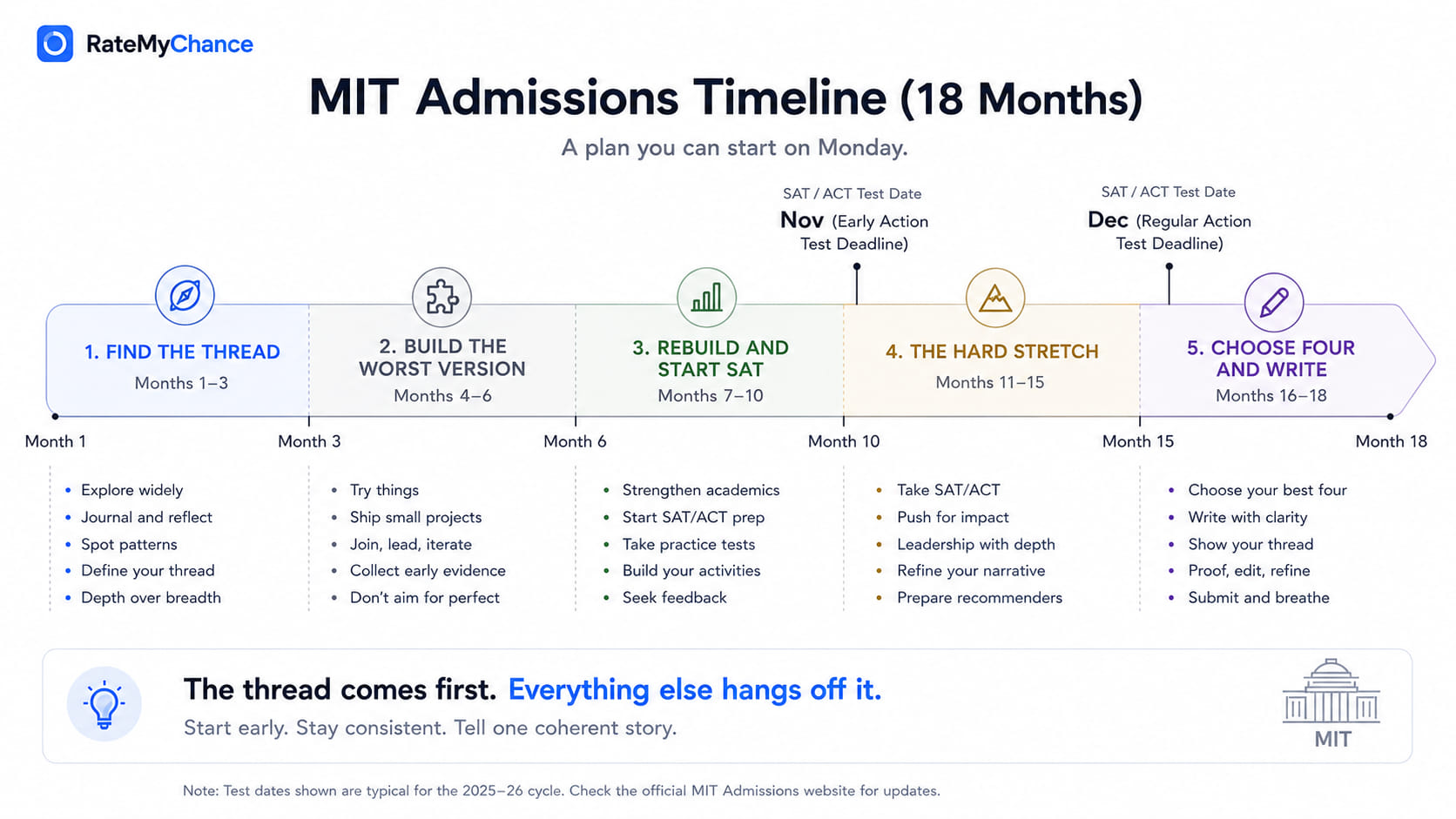
Find your thread, build the worst version, rebuild it, then choose four and write. That sequence works for any selective university. What follows is only the part that is MIT's alone, and it is the part that sets your actual calendar.
The November test date is the last SAT or ACT sitting MIT accepts for Early Action. Work backwards from that, not from the application deadline. December is the limit for Regular Action.
1 November, Early Action closes. Remember that an Early Action denial at MIT is terminal, and you cannot then apply Regular Action. That makes this a real decision rather than a free option, which is not true at most universities.
4 January, Regular Action closes.
15 February, financial aid materials. CSS Profile and IDOC, not FAFSA. Late aid paperwork is the most avoidable way to lose an offer you have already earned.
One sequencing note that only applies here. A maker portfolio is assembled from documentation gathered while you work, not reconstructed afterwards. If you are not photographing your process by roughly month ten, you will not have a portfolio worth submitting in month eighteen.
Work backwards from the November test date, not from the application deadline.
The order matters more than the dates. Chase credentials first and look for a thread later, and you arrive at four boxes with nothing worth putting in them.
What this means for you
Put four dates in your calendar now: the November test date, 1 November, 4 January and 15 February. Work backwards from the test date, not from the deadline.
Parent Corner
For parents: three things specific to MIT
Three things are particular to MIT, and worth knowing before you spend another rupee.
Do not pay for the tenth activity. MIT allows four. Programmes five through ten cannot appear on the application at all, however much they cost. This is the rare case where a university has removed the temptation for you.
Apply before deciding you cannot afford it. MIT is need-blind for international students and meets 100% of demonstrated need. The average institutional grant to an international student is $81,991, and the median family receiving aid pays about $10,268 a year against a $92,760 sticker. Choosing not to apply is the only version of this where the answer is certainly no.
Know the 2%, together, from the start. International admission runs at about 2%, and roughly four Indian-citizen students enter each year. Say it out loud early, build a list where MIT is one line among many, and the next eighteen months become something your child can enjoy rather than survive.
Frequently asked questions
There is not one. MIT does not admit by major. The overall rate for the Class of 2029 was 4.6%, and 2.0% for international applicants. Any page quoting a CS-specific figure has invented it.
No. You apply to MIT. You declare your major in the spring of your first year, and Course 6 has no cap and no internal application.
Yes, but the numbers are small. MIT had 16 undergraduates holding Indian citizenship in 2025-26, roughly four per year. This excludes US citizens and permanent residents of Indian origin.
No. MIT's own position is that no single credential admits anyone, medals included. In a pool where grades are uniformly excellent, a medal is one legible way to show extraordinary depth. Four documented years on one built thing is another, and you have four boxes to prove it in.
Not directly. MIT has no entrance exam and does not recognise JEE. It requires the SAT or ACT, and the maths preparation transfers even though the credential does not. Also worth stating plainly, because it causes real confusion: MIT in Massachusetts has no connection to MIT Pune, MIT-WPU or MIT Manipal.
No on both counts. APs are not separately weighted for admission, and your board or IB results do the same job. And AP Computer Science earns no credit at MIT, so it does not shorten your degree either. Take it if you want to learn it, not to impress anyone.
No. MIT has its own application portal, at apply.mitadmissions.org.
MIT says no. The rate difference is largely self-selection. But note that an Early Action denial is final, and you cannot then apply Regular Action.
No. MIT is need-blind for all applicants and meets 100% of demonstrated need, which is rare among American universities.
No. Interview availability depends on local alumni volunteers. MIT states a waived interview will not affect your application.
Only if you can document your build process, including failures. A polished result with no process documentation scores worse than a modest project with one.
Final thoughts
Here is something odd about MIT that we have not said plainly yet.
MIT is the only university we know of that publishes an essay instructing you not to try to get in. Applying Sideways says it directly: "don't do things because you think they will help you get into MIT." Elsewhere on the same site: "There is nothing, literally nothing, that in and of itself will get you in to MIT." And, about the forums where students trade predictions: "At their best, they cannot help you; at their worst, they do great harm."
Most universities publish a wish list. MIT publishes a warning against reading it as one.
We think you should take them at their word, and the international arithmetic is the reason why. At roughly 2%, any plan whose value depends on being admitted is a plan that fails ninety-eight times out of a hundred. That is not a reason to give up. It is a reason to choose differently.
So pick the eighteen months that were worth spending at a 0% admit rate. The thing you would have built anyway. The four boxes you would be proud of if nobody ever read them.
Then apply. If MIT says yes, you were already doing the right thing. If MIT says no, you were still doing the right thing, and you have a working product with your name on it either way.
That is not a consolation. It is the only version of this that has ever worked.
Your Profile Reality Check
Where do you actually stand?
You do not need more pressure. You need a map. Add your profile, get an honest read on where your Admission DNA is strong, where it is thin, and whether your evidence hangs together, then go build the part that does not.
Free score first · Full report $4.99 · Specific to MIT · No subscription
Where to go next
Sources
Written by the RateMyChance team. Every figure on this page comes from MIT itself.
Admissions data
MIT Admissions: admissions statistics: application, admit and enrolment counts, domestic and international split, Early and Regular Action breakdown, test ranges
What MIT does not publish. Average GPA. Any major-specific acceptance rate, including for Computer Science. The share of international applicants who receive an interview. Class of 2030 international figures. Where you see these numbers on other sites, they are reconstructions or inventions, not MIT data.
Figures are from the Class of 2029 (entering autumn 2025) unless stated, as this is the most recent cycle for which MIT has published complete data. Class of 2030 headline figures are noted where used. Last checked August 2026.
This guide is independent, is not affiliated with MIT, and is not a promise of admission.