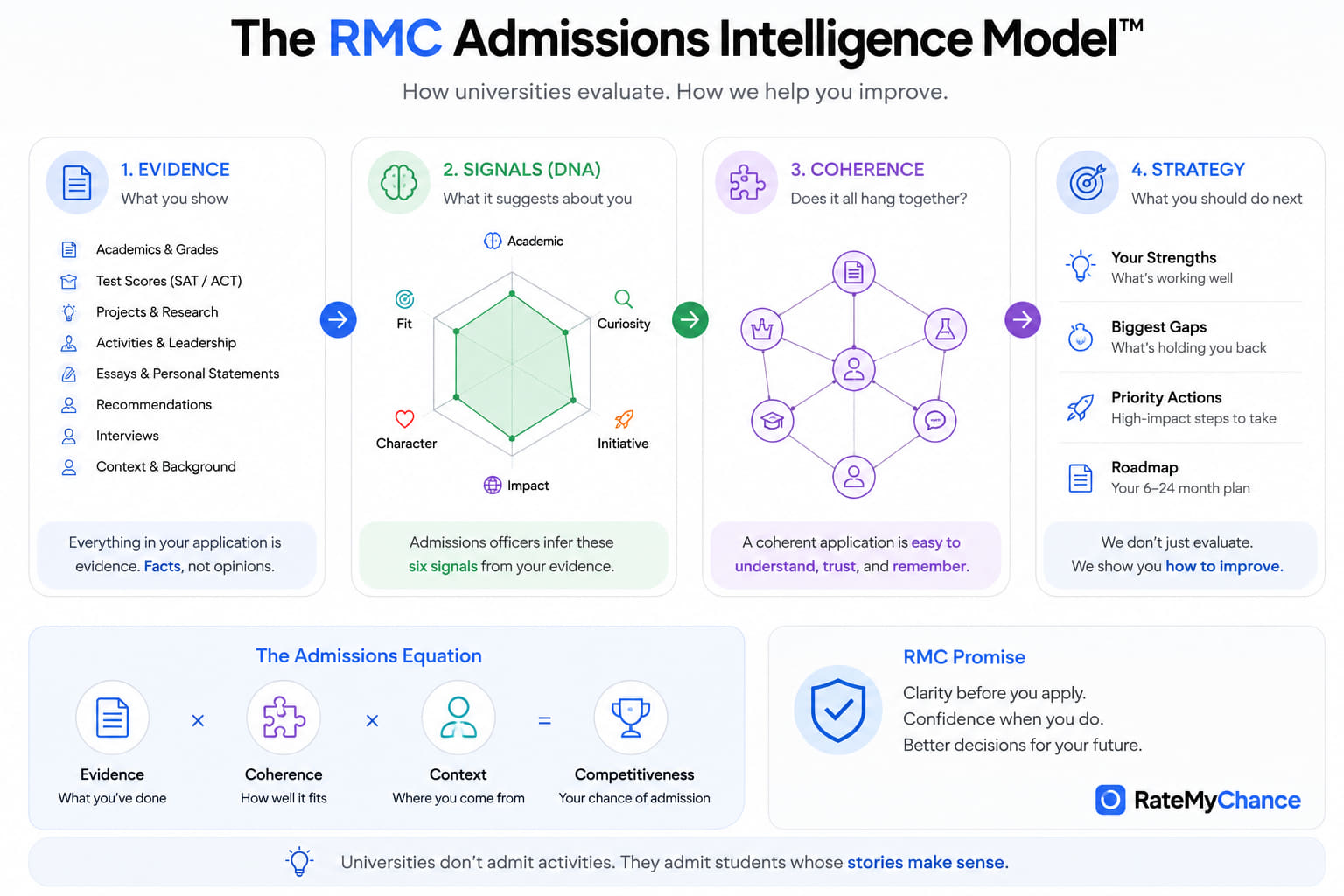
The model behind this guide. What you submit is only the first stage; coherence is where most strong applications come apart.
USA · Computer Science·21 min read
How Can an Indian Student Get Into Harvard Computer Science? (2027 Guide)
A calm, honest guide for students and parents. Built on real data. No hype. No fear. Just what actually works.
Published · Updated
The short answer
Yes. An Indian student can get into Harvard for Computer Science.
But probably not for the reason you think.
Harvard does not admit students because they have the highest marks. It rejects thousands of students with near-perfect scores every single year. It admits students whose applications hang together — students who show one clear line of curiosity, effort, and impact running through everything they have done.
Quick Harvard Facts · Class of 2029
Overall acceptance rate
≈ 4.2%Class of 2029
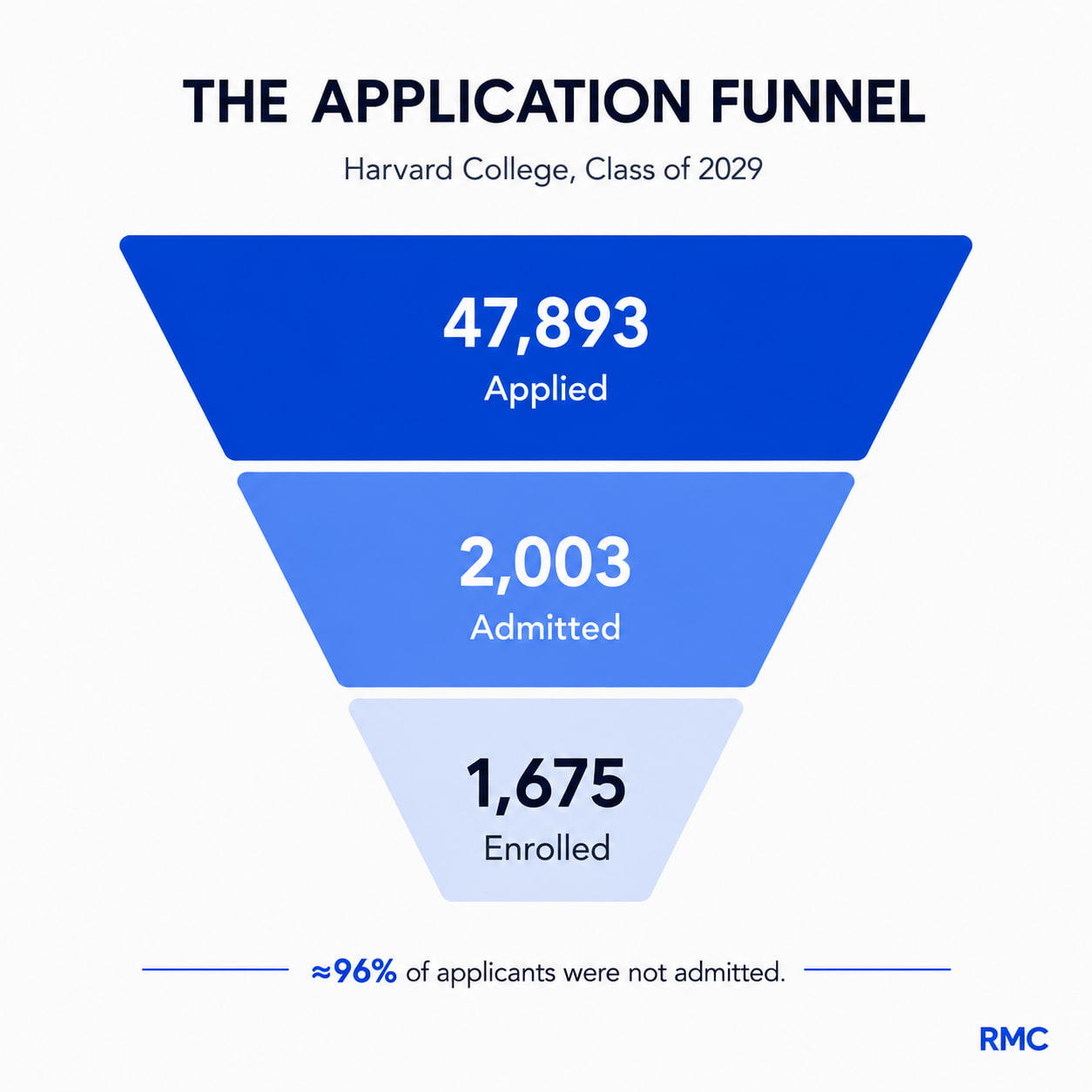
Applicants → admitted → enrolled
47,893 → 2,003 → 1,675
Early Action rate
≈ 9%
Regular Decision rate
≈ 3%
SAT range (admitted)
R/W 740–780 · Math 770–800
ACT range
34–36
Testing
SAT or ACT required again (since Class of 2029)
Deadlines
Early Nov 1 · Regular Jan 1
Global reach
92 countries in the latest class
So the honest question is not "Is Harvard possible?"
The honest question is "How do I become the kind of student Harvard says yes to?"
That is what this guide is about. Read it fully. By the end, you will understand not just what Harvard wants, but why it wants it, and exactly what you should do next.
The application funnel — Harvard College, Class of 2029. About 96% of applicants were not admitted.
What this means for you
These numbers look scary. They are meant to. But look closer: almost everyone in that pile of 47,893 has strong grades and strong scores. Grades and scores get you into the pile. They do not get you out of it. The rest of this guide is about getting out of the pile.
One important note before we start
Harvard does not publish a separate acceptance rate for Computer Science.
You will see websites claiming "Harvard CS acceptance rate is X%." They are guessing. Harvard simply does not release major-by-major numbers.
We could guess too. We will not. Here is why that matters: if a number is not real, chasing it will only make you anxious for no reason. So instead of obsessing over a fake CS acceptance rate, spend your energy on the things that actually move your chances. This whole guide is about those things.
RMC Insight
Students lose months of sleep over numbers that do not exist. A made-up "CS acceptance rate" feels like information, but it changes nothing you can control. The healthiest thing you can do early is stop measuring yourself against numbers nobody can verify, and start building the parts of your profile you can control.
Two students. Same year. Both from India.
Let me tell you about two students. They are not real people. They are the two types I see again and again.
Meet Aarav.
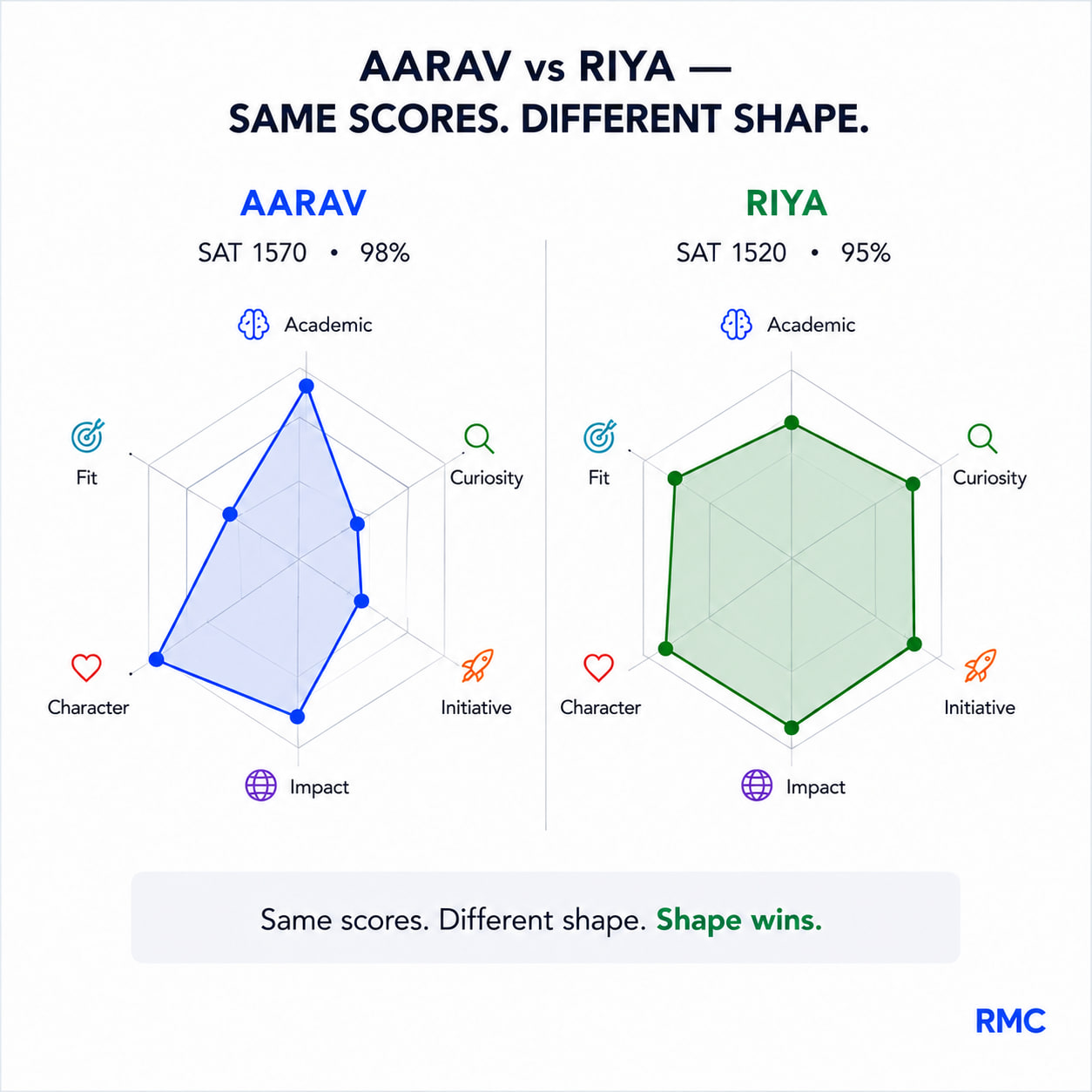
Aarav has a 98% board score. A 1570 SAT. He is school captain. He built three apps. He won two hackathons. He even has his name on a research paper.
His parents are sure he is getting in.
He is rejected.
Meet Riya.
Riya has a 95% board score. A 1520 SAT. She has one research project. But for two years, she quietly built one thing: an AI tool that reads text out loud for blind students in her city. She kept improving it. Real people use it. Her essays are about that journey, told simply and honestly. Her recommendation letters talk about the same thing.
She is admitted.
What happened?
Aarav has a list. A long, impressive list of separate things that do not connect. An app here. A hackathon there. A research paper in a totally different field. Each one is good. Together they say nothing.
Riya has a thread. One clear interest running through everything. Her project, her essay, her research, and her teachers all point in the same direction.
Same scores. Different shape. Shape wins.
What this means for you
Stop collecting achievements. Start building one thread. That is the single most important idea in this guide, and the next section explains exactly why it works.
The one idea that explains everything: coherence
Here is a secret most admissions guides never tell you.
An admissions officer is a human being. They read your file for a few minutes. They do not calculate a score in their head. They get a feeling. And the feeling that gets students admitted is when an application "hangs together."
Scientists have a name for this. They call it cognitive fluency. It means the human brain trusts and remembers things that are easy to understand. A messy application is hard to understand, so it is easy to forget. A clear, connected application is easy to understand, so it sticks.
When every part of your application points the same way, the officer feels like your admission is obvious. Your project, your essay, your research, your teacher's letter all whisper the same story. The application feels, in one word, inevitable.
That is why Riya beat Aarav. Not more impact. Not more grades. Coherence.
Most weak applications do not fail because the student lacked ability. They fail because they lacked coherence. The strongest evidence points in three unrelated directions, so the officer never forms a clear picture of who the student is. If you remember one sentence from this guide, remember this: universities do not admit activities. They admit a believable story built from evidence.
What this means for you
Before you add one more activity, ask a harder question: does everything I have done point in the same direction? If not, your next move is not to add more — it is to go deeper on the one thing that is truly you.
Why Harvard Computer Science is different
Harvard is not just famous. For Computer Science, it has a few real strengths worth knowing.
Its beginner CS course, CS50, is one of the most well-known university courses in the world. Millions of people have taken it online, for free. That tells you something important: Harvard is very good at teaching computer science to curious beginners, not just to people who already code well.
Its engineering and CS school (called SEAS) sits right next to world-class labs in AI, biology, and data. Students often mix computer science with another field, like medicine, climate, law, or economics. The area around Harvard is full of startups and research money.
So here is the honest truth about Harvard CS, and it is a bit different from schools like MIT: Harvard does not want the student who only loves code for its own sake. It wants the student who uses code to solve a problem in the real world.
RMC Insight
This is why "I am good at coding" is a weak angle for Harvard. It describes a skill. Harvard admits directions, not skills. "I use code to make buses run better in my city" is a direction. The skill is assumed. The direction is what makes you memorable.
In your application, show how you use computer science to solve a problem you actually care about. That fits Harvard far better than raw coding ability.
First, understand this: you do not apply to "Harvard CS" directly
This surprises most Indian families, so read carefully.
At many universities, you apply straight into a major. At Harvard, you do not. You apply to Harvard College, the general undergraduate school. You choose your subject (Harvard calls it a "concentration") later, usually in your second year.
So there is no separate "Harvard CS application" with its own cutoff. You apply to Harvard as a whole person. You show your love for computer science through your projects, essays, and choices. But you are admitted to the College, not to a department.
What this means for you
You cannot find a CS-only backdoor. You have to be a strong, interesting applicant overall, with a clear pull toward computer science shown through what you have actually built.
The biggest myth: "I need a 1600 SAT"
No, you do not.
Yes, test scores matter again. Harvard brought back the SAT and ACT requirement for the Class of 2029. When it did, applications dropped by about 11%. So you must submit a score, and it should be strong. Most admitted students score in the top 1% in the country.
But here is the truth that scares people: Harvard rejects thousands of students with perfect or near-perfect scores every year.
A top score does not make you special at Harvard. Almost everyone applying has one. A top score simply stops you from being cut early. After that, it does nothing to help you stand out.
RMC Insight
Think of the SAT like a passport at an airport. Without it, you cannot board. But nobody gets upgraded to first class because their passport is extra valid. Once your score clears the bar, more points buy you nothing. Your energy has to move somewhere else.
If your SAT is below about 1450, raise it — that is your priority right now. If it is already above about 1550, stop chasing another 20 points; they will not change your result. Build something real with that time instead.
What Harvard actually looks for: your Admission DNA
Harvard does not admit students on one number. It reads your whole application and quietly asks a few big questions about who you are.
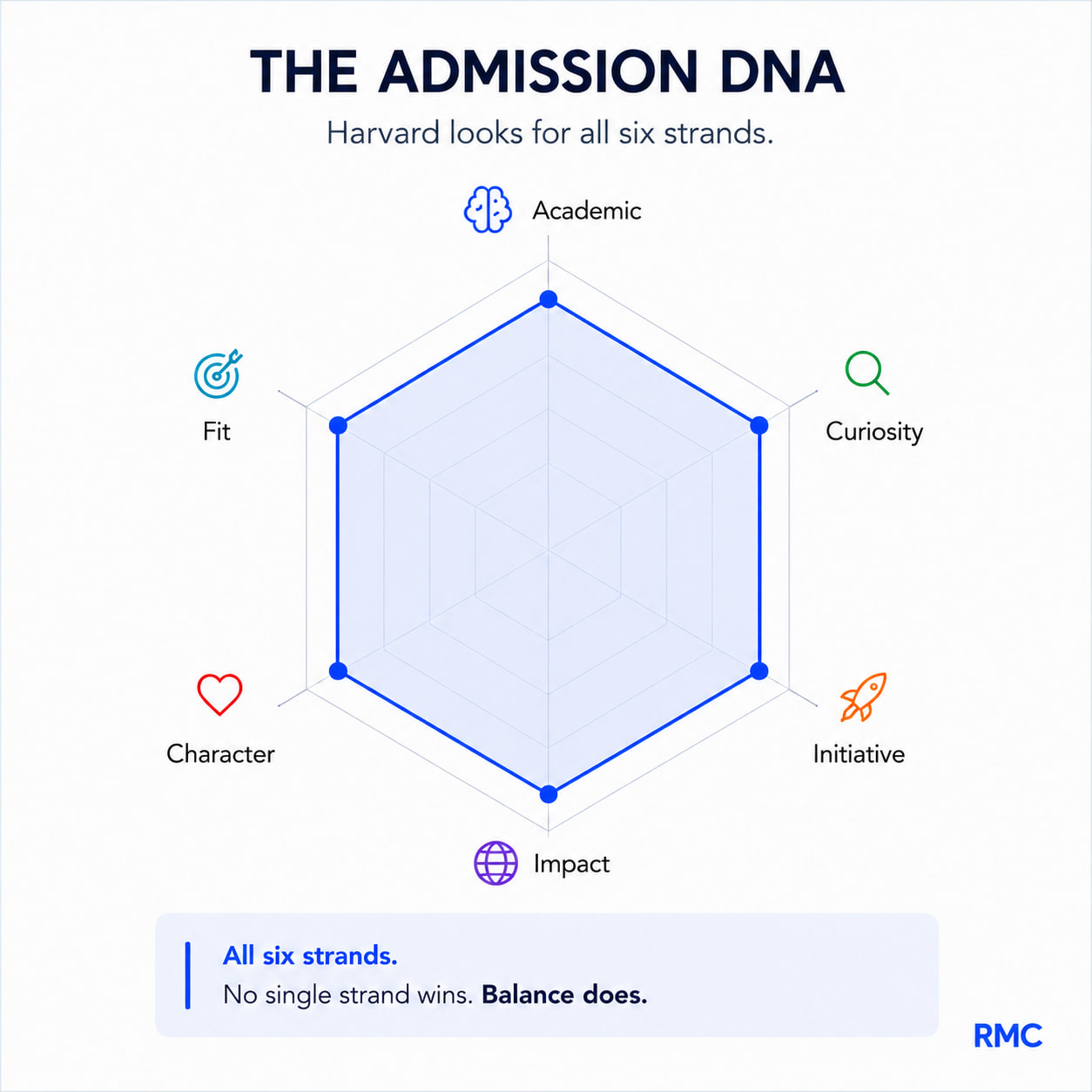
We call the answers your Admission DNA. Every applicant sends six signals:
🧠 Academic — Can you handle the work?
🔍 Curiosity — Do you genuinely love learning?
🚀 Initiative — What did you start on your own?
🌍 Impact — Who or what changed because of you?
❤️ Character — Who are you when nobody is watching?
🎯 Fit — Will you thrive here and make this place better?
Weak applicants are strong in one strand and empty in the rest. Aarav was all Academic and nothing else. Strong applicants light up several strands — and, crucially, all their evidence points at the same strands. That is coherence again.
The Admission DNA — Harvard looks for all six strands. No single strand wins; balance does.
Keep these six in mind. Every section below strengthens one or more of them.
"But what about me?" Honest answers to real worries
Before we go deeper, let me answer the worry that makes most readers quietly close this tab. Many guides pretend every reader is a rich student at a fancy city school. You might not be. Here are honest answers to the worries we hear most.
"I live in a small town with few opportunities." This can be a strength, not a weakness. Harvard reads your file in the context of where you are. A student who built something meaningful with almost no resources looks more impressive than a city student who had everything handed to them. Your context makes your effort shine brighter, not dimmer.
"I cannot afford research programs or expensive courses." Good news: the best evidence is usually free to create. Building a project costs nothing but time. Open-source work is free. Teaching younger students is free. Harvard is not counting how much money you spent — it is looking at what you did with what you had.
"My school has no clubs or coding culture." Then start one. A student who creates an opportunity that did not exist is showing the Initiative strand at its strongest. "There was no coding club, so I made one" is a better story than "I joined the coding club."
"My English is not perfect." Your essay does not need fancy words. It needs a true story told simply. Clear and honest beats fancy and hollow, every time. Simple English written by a real person is exactly the voice Harvard trusts.
"I started late. Am I finished?" No. You cannot control the past. You can control the next twelve months. One year of focused, coherent effort beats three years of scattered activity. Start today, on one thing, and go deep.
RMC Insight
Notice that every honest answer above points back to the same two ideas: coherence and context. Harvard is not comparing you to a perfect student in a vacuum. It is asking, "What did this person do with their situation?" That is a question you can win.
Why curiosity matters more than intelligence
Here is an idea most guides miss.
Harvard already receives thousands of applicants who can solve hard problems. Raw intelligence is no longer rare. Almost everyone in the pile has it.
Curiosity is rare.
Curiosity predicts something intelligence cannot. It predicts what you do when nobody gives you homework. It answers the one question hiding behind every admissions decision:
RMC Insight
"If we remove grades and exams from this student's life, will they keep learning anyway?"
The student who codes only for marks stops the day the exam ends. The student who codes because a problem fascinates them never stops. Harvard is betting on the second student, because that is the student who becomes someone remarkable.
What this means for you
Find the part of computer science you would explore even if it were never graded. Then go there. That is your Curiosity strand, and it is worth more than another exam point.
Academics: grades, board, and scores
Harvard reads your marks in the context of your board. A 95% in CBSE, a strong IB predicted score, and a strong set of A-Level grades are all read differently. Admissions officers know Indian boards well. They look at whether you took the hardest subjects available to you, especially in math and science, since you are pointing toward CS.
For a CS applicant, strength in mathematics matters most. Strong math tells Harvard you can survive the hardest parts of the degree.
On testing: submit a strong SAT or ACT. In rare cases where a student truly cannot access the test, Harvard may accept other exams like AP, IB, or A-Levels, but treat testing as required, not optional.
What this means for you
Take the hardest math and science your school allows. Score well. Then stop. Academics are the entry ticket, not the prize.
The Resume Trap
Here is the mistake that sinks the most strong students.
They believe that more is better. More clubs. More certificates. More titles. More activities. They fill every hour.
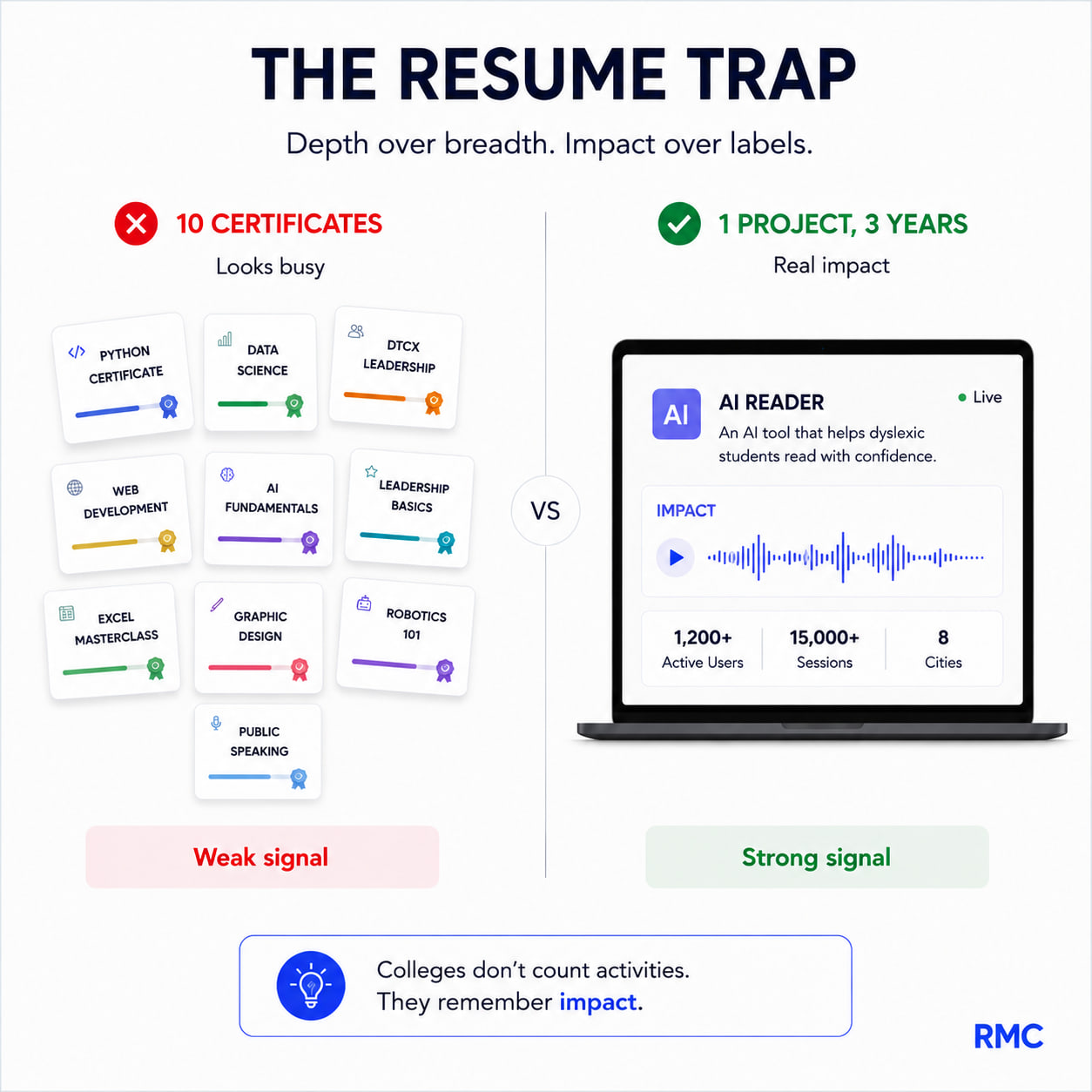
It backfires. Here is the picture:
Depth over breadth. Colleges don't count activities — they remember impact.
Ten shallow activities create noise. The officer cannot tell what you care about, so they remember nothing. One deep commitment creates a signal. The officer knows exactly who you are.
RMC Insight
A long activities list often lowers your chances, because it destroys coherence. Every unrelated item is one more direction your story points in. Sometimes the strongest move a student can make is to drop activities, not add them.
Cut your list in half. Go twice as deep on what remains.
Should you even do research?
Most guides say "do research." We think that is the wrong instruction.
Research is not the thing Harvard values. Research is just one way to produce the thing Harvard values, which is evidence of real curiosity and initiative.
A serious personal project can produce the exact same evidence. So can an open-source contribution, a small startup, a nonprofit, or even a really good YouTube channel that teaches something hard. Riya did not have a famous paper. She had two years of real work on one tool. That was enough.
And bad research actively hurts you. A paper you clearly did not understand, bought, or barely touched is easy to spot, and it looks worse than no paper at all.
What this means for you
Do not chase a paper for the label. Do real work you can explain in your own words. The signal matters. The format does not.
Projects that impress
The best projects share three things:
They solve a real problem you actually cared about.
You worked on them over time, not in one weekend.
You can clearly explain the problem, your choices, and what happened.
A weather app copied from a tutorial does nothing. A simple tool you built to solve a real problem in your own life or town, improved over many months, means everything — even if it looks small.
What this means for you
Choose a problem close to you. Build the smallest useful version. Then keep improving it. That long, honest story is gold.
Essays that admissions officers remember
Your essay is where your thread becomes real.
Weak essays list achievements. Strong essays put the reader inside one specific moment. Riya's essay did not say "I am passionate about helping people." It described the exact day she watched a blind classmate struggle to read a notice, and what she decided to do about it.
Write like you talk. Be specific. Use small, true details. Do not try to sound impressive. Try to sound like a real person the reader would want to know.
What this means for you
Do not write about all six of your activities. Write about one true moment, deeply. Specific beats impressive every time.
Recommendation letters
Harvard wants teachers who know you, not just teachers who taught you.
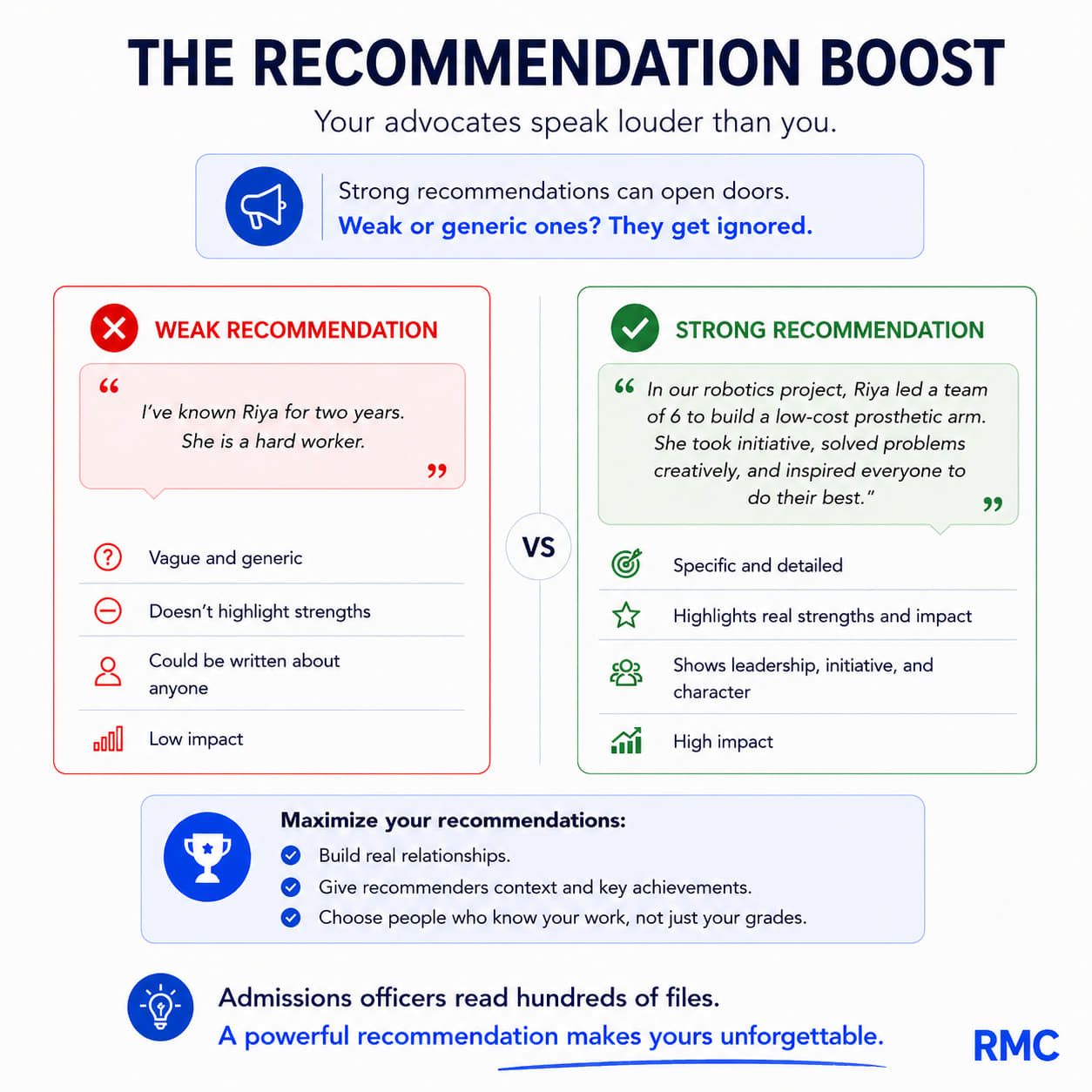
A letter that says "she was a good student who scored well" is weak. A letter that says "she stayed back for weeks to help me redesign how we teach loops to the junior class, and here is the exact thing she built" is powerful. The second letter also confirms your thread, which strengthens coherence.
A weak, generic letter versus a specific, powerful one. A strong recommendation makes your file unforgettable.
What this means for you
Build real relationships with two teachers over time. Let them see your curiosity up close, so they can describe it in detail.
Common reasons strong applicants get rejected
Here is why students like Aarav get turned away, even with great numbers:
Twenty five activities, none of them deep.
A pile of certificates that took an afternoon each.
Essays that list instead of tell a story.
Research they clearly did not understand.
Generic recommendation letters.
Applying only because their parents wanted the Harvard name.
Every one of these is the same mistake wearing a different mask: width without depth, and pieces that do not connect.
What this means for you
Coherence first. Depth second. Volume last.
The money question: can an Indian family afford Harvard?
This is the fear that stops many families before they even try. The answer will surprise you.
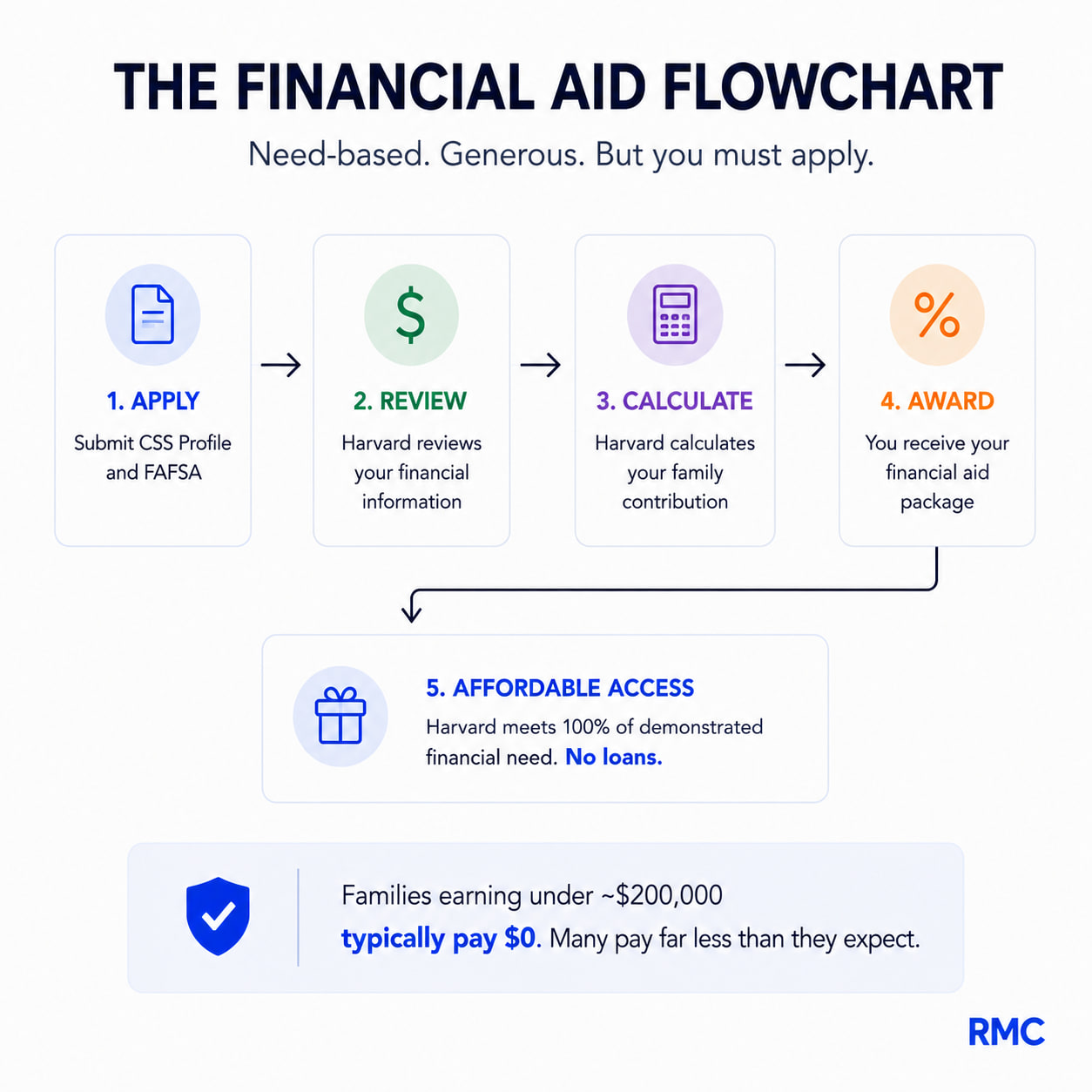
Harvard is need-blind. That means when Harvard decides whether to admit you, it does not look at whether your family can pay. This includes international students, so it applies to you as an Indian applicant. Asking for financial aid does not lower your chances.
Harvard also promises to meet 100% of your demonstrated financial need. And starting in the 2025 to 2026 year, the aid became even bigger:
If your family earns under about $100,000 a year, you pay nothing at all. Tuition, housing, food, health insurance, even travel, covered.
If your family earns under about $200,000 a year, tuition is free.
Many families earning more than that still get real aid.
These aid tiers apply to international families too. So the real picture for many Indian families is this: Harvard can cost less than a good private college back home. The sticker price is not the price you pay.
Need-based, generous — but you must apply. Families earning under ~$200,000 typically pay $0.
What this means for you
Do not remove Harvard from your list because of money. Apply for aid. Use Harvard's official Net Price Calculator with your real family numbers — the likely cost is often far lower than families expect.
If I were 16 again, and Harvard CS was the goal
Enough theory. Here is exactly what I would do, month by month, if I were an Indian student in Class 11 today with this goal. This is the plan behind all the ideas above.
Months 1 to 2: Find the thread.
I would not touch essays or SAT prep yet. I would spend two months finding one problem I genuinely care about. Something in my own life or town — accessibility, local transport, a subject I love, anything real. Everything else in my application will grow from this one root.
Months 3 to 6: Build the smallest real thing.
I would build the tiniest useful version of a solution to that problem. An app, a tool, a study group, a small nonprofit. It does not need to be big. It needs to be real, and it needs to be mine. I would get one real user, then two.
Months 7 to 10: Go deep, and start the SAT.
I would keep improving my one thing, adding real users or real results. In parallel, I would begin steady SAT or ACT prep. I would also pick two teachers and start doing genuine work with them, so they truly know me.
Months 11 to 14: The busy stretch.
I would take the SAT, and retake once if needed. I would hit a real milestone on my project. I would draft my main essay early, writing about one true moment from my journey, not a list. If Harvard were clearly my first choice, I would prepare for the Early Action deadline of November 1.
Months 15 to 18: Finish clean.
I would polish essays, confirm my teacher letters, and submit by the January 1 regular deadline if I had not applied early. I would apply for financial aid at the same time.
What this means for you
Notice what comes first: not the SAT, not the essay — the thread. Get that right and everything else becomes easier, because it all connects.
What Harvard CS is really like
A quick, honest picture of the place, so you know what you are working toward.
Computer science at Harvard sits inside its engineering school. What makes it different from a pure coding school is that students are encouraged to mix computer science with another interest, like medicine, climate, law, or art. This fits Harvard's whole style: use code to solve real problems, not just to write code.
The most famous course is called CS50. It is Harvard's introduction to computer science, and it is known around the world for making hard ideas easy to understand. Millions of people have taken it online for free. It tells you something true about Harvard CS: they care about teaching curious beginners well, not just training people who already code.
Where do Harvard CS students go afterward? Some become researchers. Some join top technology companies. Some go to graduate school. Many start their own companies. We will not throw salary numbers at you, because honest, current figures are hard to pin down and they change every year. The thing that matters is the direction. This is a place that rewards students who build things and connect ideas, not students who only memorize.
What this means for you
You are not aiming at a logo. You are aiming at a specific kind of learning. Make sure, in your own heart, that it is the kind you actually want.
Parent Corner
For parents: please read this part carefully.
Many parents believe admission is mostly about marks and coaching. At a school like Harvard, marks get your child into the conversation. They almost never win it.
The students who get in usually have four things: one real interest they genuinely enjoy, pursued over years; proof of initiative outside the classroom; teachers who know them well enough to write detailed letters; and a story that connects their activities, not a random list.
Here is the hard part for loving parents. Your job is not to build your child's resume. Adding more classes, more certificates, and more tuitions usually makes the application weaker, because it creates width without depth and breaks the very coherence Harvard is looking for.
Your real job is to create the time, space, and support for your child to explore one thing deeply. Protect their time. Encourage curiosity. Resist the urge to fill every hour. Be a coach, not a project manager. That is how strong applications are actually built.
Frequently asked questions
Yes. Indian students are admitted every year. You are competing in a global pool, so a clear, coherent story matters even more.
No. Olympiads help, but they are one path among many. A serious personal project or research can be just as strong.
No. JEE shows strong exam skill in math and physics, which is good. But Harvard also wants curiosity, projects, essays, and a story. JEE prep alone does not build those.
Helpful, not required. What matters is proof that you can think deeply about a real problem. Research is one way. A real project is another.
Not required. Strong board results plus the SAT or ACT are the main academic signals. APs can add strength if you have them.
Yes. The SAT or ACT is required again. Submit a strong score.
You have time to learn. But if you want to study CS, show a growing, genuine interest in it through your choices before you apply.
Fewer than you think. One or two deep, connected ones beat a long shallow list.
Final thoughts
Getting into Harvard for Computer Science is hard. That is true. But it is not a lottery, and it is not only for students with perfect scores and rich parents.
It rewards a specific kind of student: curious, focused, and honest. Someone who went deep on one real thing, can tell that story clearly, and shows it across every part of their application so the whole thing hangs together.
You have more control over this than you think. Not over the result. But over the work. And the work is where every strong application is actually built.
Here is the last thing worth sitting with.
Most students spend years trying to look impressive. The strongest applicants spend those same years becoming interesting. There is a real difference between the two. Impressive is what you did. Interesting is why you kept doing it.
Harvard can teach you computer science. It cannot teach you genuine curiosity. That part was always your job. Start there, and everything else in this guide becomes easier.
Your Profile Reality Check
How close are you today?
Most students do not need more motivation. They need clarity — an honest read on where their Admission DNA is strong, where it is weak, and whether their story hangs together. Add your profile, get an honest AI evaluation, see what to fix first, then go build it. You do not need more pressure. You need a map.
This guide is for information and guidance. It is not a promise of admission. Admissions decisions depend on many factors that no guide or tool can see, and they change from year to year.